
Types of Business Analytics With Examples (A Practical Guide)
When I first started hearing terms like predictive analytics and business intelligence in meetings, I used to nod along and hope no one asked me what they meant. It felt like everyone else had cracked a code I didn’t understand.
But after years of working with teams and helping businesses make data-driven decisions, I realized something important: the Types Of Business Analytics aren’t complicated. At their core, they simply help businesses answer better questions.
In this guide, I’ll break down the Types Of Business Analytics with examples, explain the tools professionals actually use, clarify the Difference between Business Analytics and Data Analytics, and simplify the often confusing comparison of Business Analytics vs. Data Analytics vs. Business Intelligence.
The Three Core Questions Behind All Types Of Business Analytics
If you strip everything down, all Types Of Business Analytics revolve around three key business questions:
- What happened?
- What will happen next?
- What should we do about it?
Let’s break them down with simple examples.
1. What Happened? (Descriptive Analytics)
This is the foundation of all Types Of Business Analytics.
Example:
A small bakery reviews last month’s sales data and sees that cinnamon rolls sell out every Friday by 11 AM.
That’s descriptive analytics — simply reporting facts.
It doesn’t explain why it happened or what to do next. It just answers: What happened?
2. What Will Happen Next? (Predictive Analytics)
Predictive analytics uses historical data to forecast future outcomes.
Example:
If the bakery sells out every Friday, and there’s a local festival next week, predictive models suggest demand will increase significantly.
This is where more advanced Types Of Business Analytics tools like Python or forecasting models come into play.
3. What Should We Do? (Prescriptive Analytics)
This is the most advanced of the Types Of Business Analytics.
It recommends specific actions.
Example:
The bakery system suggests:
- Bake 4 batches instead of 2
- Prepare extra iced coffee
- Schedule two additional staff members
This is actionable intelligence.
What Are the 4 Types of Business Analytics?
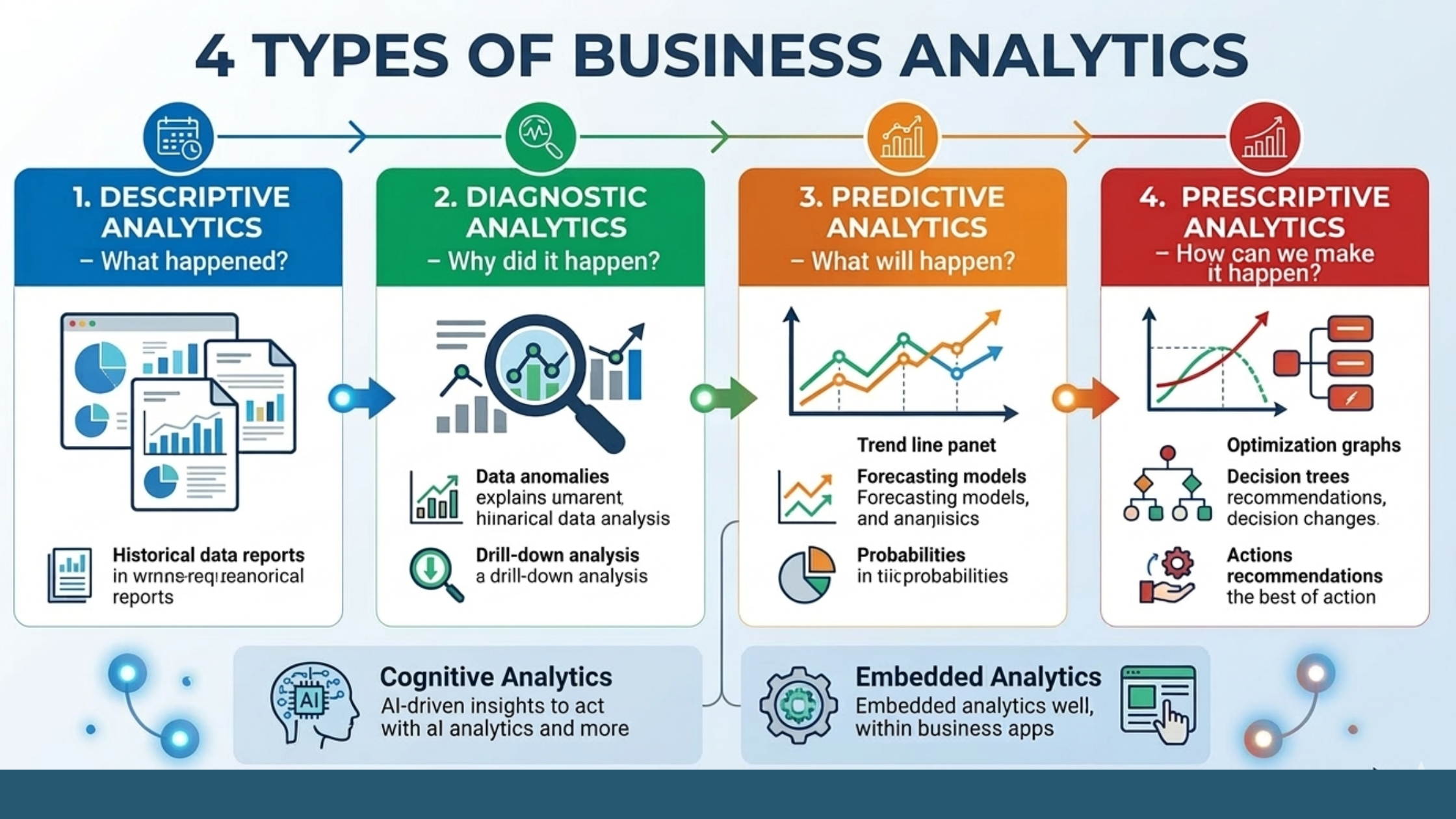
Many professionals ask: What are the 4 types of business analytics?
Here’s the complete breakdown:
- Descriptive Analytics – What happened?
- Diagnostic Analytics – Why did it happen?
- Predictive Analytics – What will happen?
- Prescriptive Analytics – What should we do?
These four form the foundation of all Types Of Business Analytics used across industries.
Diagnostic Analytics (The “Why” Factor)
Diagnostic analytics investigates root causes.
Example:
An e-commerce company sees a sudden spike in sales. After analysis, they discover a competitor’s website had a broken checkout button.
That’s diagnostic analytics — understanding why something happened.
Among all Types Of Business Analytics, diagnostic analysis often delivers the most surprising insights.
What Are the 4 Types of Data?
Since analytics relies on data, it’s important to answer: What are the 4 types of data?
- Structured Data – Organized data (spreadsheets, databases)
- Unstructured Data – Social media comments, emails
- Semi-Structured Data – Log files, JSON, XML
- Metadata – Data about data (timestamps, file info)
Understanding data types is critical across all Types Of Business Analytics.
Business Analytics vs. Data Analytics vs. Business Intelligence
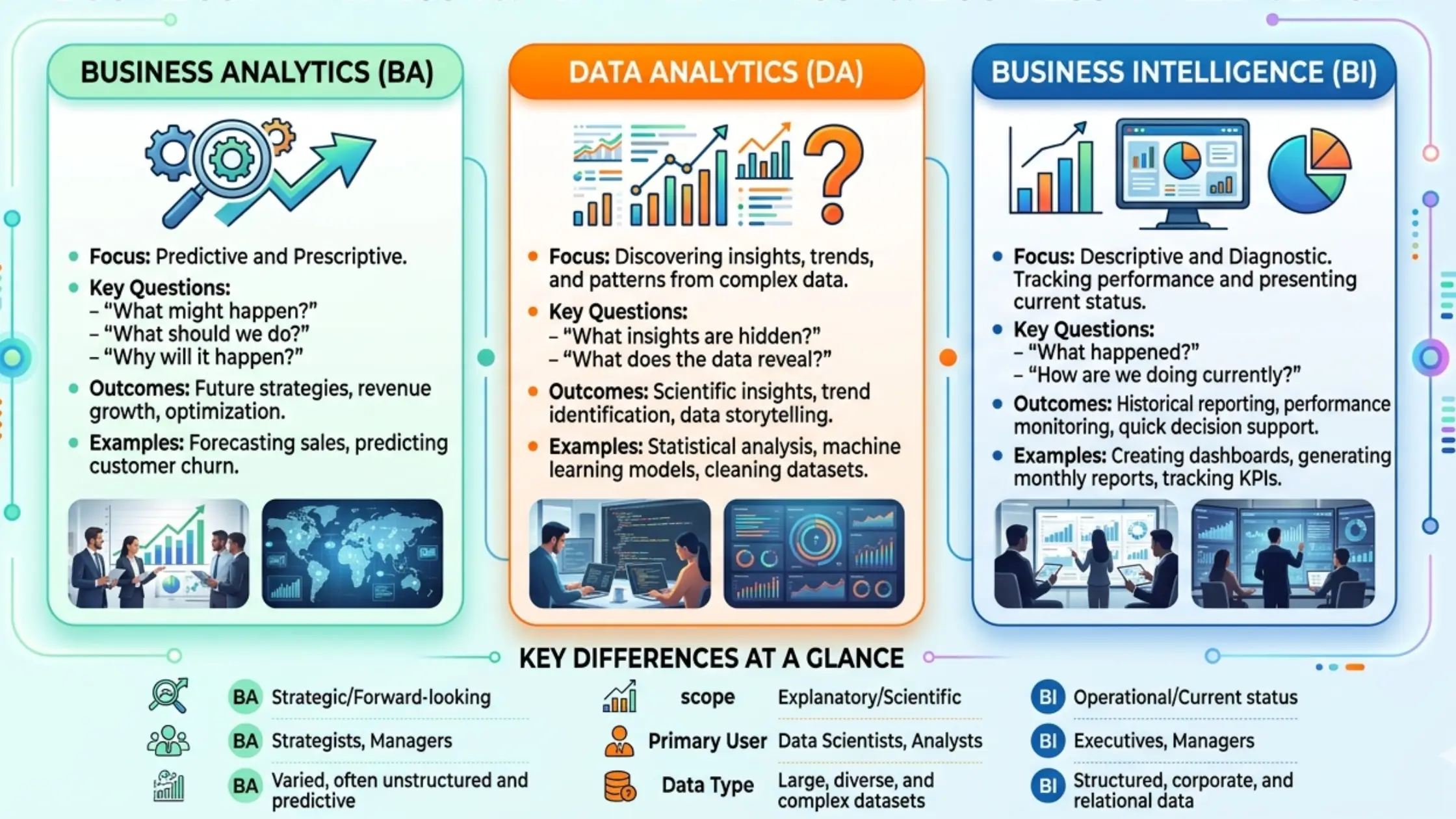
One of the biggest sources of confusion in this field is the comparison of Business Analytics vs. Data Analytics vs. Business Intelligence.
Let’s simplify it.
Difference Between Business Analytics and Data Analytics
The Difference between Business Analytics and Data Analytics lies in focus and purpose.
- Data Analytics focuses on collecting, cleaning, and analyzing raw data.
- Business Analytics focuses on using that analysis to make strategic business decisions.
In short:
- Data analysts work with data.
- Business analysts work with decisions.
Understanding the Difference between Business Analytics and Data Analytics is essential if you’re exploring career paths.
Difference Between Business Analytics and Business Intelligence
The Difference between Business Analytics and Business Intelligence is about time orientation.
- Business Intelligence (BI) focuses on reporting current and past performance.
- Business Analytics (BA) focuses on predicting future outcomes and recommending actions.
So the Difference between Business Analytics and Business Intelligence is:
- BI tells you what is happening.
- BA tells you what to do next.
This distinction is crucial when evaluating Types Of Business Analytics tools in the market.
Must Read : Top 10 AI Skills That Will Get You Hired in 2026
Types Of Business Analytics Tools Professionals Actually Use
When discussing Types Of Business Analytics tools, they generally fall into these categories:
1. Excel
Still one of the most widely used tools for descriptive and diagnostic analysis.
2. SQL
Essential for querying databases and extracting structured data.
3. Tableau / Power BI
Popular visualization platforms for dashboards and reporting.
4. Python / R
Used for predictive and prescriptive modeling.
Choosing the right Types Of Business Analytics tools depends on the problem you’re solving.
How Many Types of Data Analytics?
Many beginners ask: How many types of data analytics are there?
The answer aligns with the four core Types Of Business Analytics:
- Descriptive
- Diagnostic
- Predictive
- Prescriptive
These represent the evolution of analytics maturity within organizations.
The 7 Stages of Business Analysis
If you’re wondering, What are the 7 stages of business analysis?, Here’s the practical version:
- Problem Identification
- Stakeholder Discussion
- Requirements Gathering
- Solution Design
- Development
- Implementation
- Performance Evaluation
These stages support the execution of all Types Of Business Analytics initiatives.
What Skills Are Required for a Career in Business Analytics?
If you’re considering this path, here are essential skills:
- Stakeholder communication
- Strategic thinking
- SQL knowledge
- Data storytelling
- Basic understanding of predictive modeling
These skills help bridge the gap in Business Analytics vs. Data Analytics vs. Business Intelligence roles.
Must Read : Top Benefits of Learning Power BI for Data Visualization
What Skills Are Required for a Career in Data Analytics?
For data analytics roles, technical depth matters more:
- SQL expertise
- Python or R
- Data cleaning and transformation
- Statistical knowledge
- Data visualization
Understanding the Difference between Business Analytics and Data Analytics helps determine which path aligns with your strengths.
Final Thoughts
The world of analytics can feel overwhelming, but once you understand the Types Of Business Analytics, everything becomes clearer.
Whether you’re comparing Business Analytics vs. Data Analytics vs. Business Intelligence, choosing between career paths, or learning new Types Of Business Analytics tools, remember this:
Analytics is ultimately about curiosity.
It’s about asking better questions and making smarter decisions.
And the best time to start learning the Types of Business Analytics?
Right now.
Frequently Asked Questions
Descriptive, Predictive, and Prescriptive analytics are traditionally considered the three major types.
Problem identification, stakeholder discussion, requirements gathering, solution design, development, implementation, and performance evaluation.
Structured, Unstructured, Semi-Structured, and Metadata.
There are four main types: Descriptive, Diagnostic, Predictive, and Prescriptive.
Strategic thinking, SQL, stakeholder communication, and data storytelling.
SQL, Python/R, statistics, data cleaning, and visualization expertise.







Leave a Reply