

Big Data Hadoop is a powerful framework designed to store, process, and analyze large volumes of data in a distributed computing environment.
Big Data Hadoop Training
Download Brochure
Get Quick Call Back Explore Course


Training By Industrial Expert

Placement upto 40 LPA

Flexible Learning Options

Career Mentorship & Job Placement


Big Data Hadoop Training Institute in Gurugram and Delhi NCR
Big Data Hadoop is a powerful framework designed to store, process, and analyze large volumes of data in a distributed computing environment. At its core, Hadoop consists of two main components: the Hadoop Distributed File System (HDFS) for storing data across multiple nodes in a cluster, and the MapReduce programming model for processing and analysing data in parallel.
Hadoop’s ecosystem includes various tools and technologies that complement its core functionality, such as Apache Hive for data warehousing, Apache Pig for data manipulation, Apache Spark for in-memory data processing, and Apache HBase for real-time database operations.

Big Data Hadoop Course Details
Data is an imperative part of any organization. Every company generates huge amount of real time or batch data. That’s how big data plays an essential role irrespective of domain and authority. This comprehensive course is curated to fulfil such requirements so that we will be able to work with an extremely large amount of data.
Big Data Hadoop Course Highlights
This course provides an in-depth understanding of Big Data and Hadoop ecosystem components. It covers the fundamentals of Hadoop architecture, Hadoop Distributed File System (HDFS), and various tools and frameworks within the Hadoop ecosystem such as MapReduce, Hive, Pig, HBase, and Spark. The course is designed to equip students with the skills required to handle, analyze, and process large datasets using Hadoop technologies.
Who Should Enroll:
- Data Analysts
- Data Scientists
- Software Developers
- Business Intelligence Professionals
- IT Administrators

Programming Tools & Language


Online Classes
we offer both online and offline classes with a strong focus on technical skills, real-world tools, and industry-relevant projects—allowing you to learn at your own pace, anytime, anywhere.

Weekdays Classes
weekly classes led by industry experts, focused on real-time projects and only the most relevant tools and topics—no fluff, just job-ready skills.

Weekend Classes
weekend classes designed for working professionals, making it easy to upskill without disrupting your job. Learn directly from industry experts through real-world projects and practical tools that fast-track your growth.


Don't Just Take Our Word For It. See How TrainingYA Transformed Lives

Pramod Singh
The Business Analytics course at TrainingYA (Earlier CTC) Data Science Training Institute provided me with knowledge of the industry demanded tools. Along with this, I get an opportunity to practice my skills through various assignments and case studies that are given to us in the workshops and classes. The trainers start the course with basic classes which gave us an introduction to the various tools. I have been very satisfied with my learning experience so far with TrainingYA.

Yushant Karki
The faculty members at TrainingYA are very supportive. I had joined their 360 Degree Data Science course as I was a fresher from a non-technical background who wanted an in-depth knowledge of the field of Data Science. They started all the concepts right from the basics which I was able to get a hold of easily. Their workshops made it even easier for me to understand all the concepts as I got hands on experience. I am still learning at the institute and hope I can get placed with their help just like the others whom I have seen getting placed.

Aman Rawat
TrainingYA (Earlier CTC) helped me a lot to enhance my skillset. I learned different tools here and as I was a newbie in this field so they started from the very basic for better understanding. The best thing about TrainingYA is that they focus on market trend and practical knowledge so that one can easily get in the industry even if they are not from the technical background. I have seen fresher’s and experienced people from various backgrounds get jobs into the world of Data Science with the help of TrainingYA. The best part if you can go as per your own speed. They truly know who to turn a profile around.

Tanya Hora
I would very much like to recommend TrainingYA (Earlier CTC) Data Science institute to everyone looking for a transition. I joined this institute recently and have been every happy with the learning. They are very dedicated towards practical knowledge and focus on the same through case studies and assignments. Along with this they conduct mock interviews to prepare us for the placement interviews. I am very satisfied with their training program. They have got some of my classmates placed in just 2 months from joining. I am going through the placement process as of now and I am hopeful that I will so get placed too. My college friend who recommended me this institute is already placed in Vortex organisation in just 45 days after joining. I am very optimistic and thank for TrainingYA for all their efforts.

Yatin Wasen
I believe that TrainingYA (Earlier CTC) institute is the best training institute for Data Science. I joined their 360-degree Data Science Course as I did not belong to a technical background and still wanted an in depth knowledge of the Data Science field. TrainingYA provided me with relevant and practical knowledge through workshops, case studies and assignments. They helped me throughout my transition period from Commerce background to the Data Science world. The faculty members were all experienced and very supportive. They were all working professionals and had experience of 8+ years. So their way of teaching gave us an insight into how things actually happen in the industry. I got my first offer within 1.5 months of joining the course. Currently, I have not completed the course. But I have already been placed through the course. Within completing only 30% of the course I had got 3 offers. So, I would recommend everyone who wishes to have a transition in their career to join TrainingYA Institute they truly helped me a lot.

Manisha Sardana
Hi I recently joined TrainingYA, the Data Science Institute because I was looking for a top-notch program that would teach me how to use data in a real-world setting. I’m so glad I found the Institute at Gurugram. The faculties at this Institute are some of the best in the industry, and they’ve been incredibly supportive. I will surely recommend this to all.
Explore More Courses
Join our industry-oriented courses to build high-in-demand career skills for a brighter future!
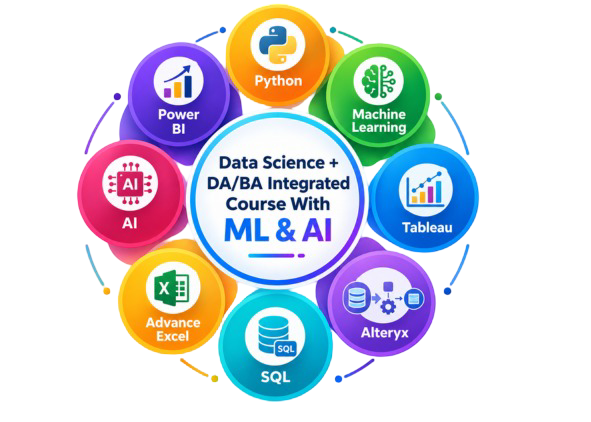
Data Science + DA/BA Integrated Course With ML & AI

Data Analytics/BA with Tableau + Power BI + SQL + Excel

Python Analytics with Machine Learning
(SQL + Excel free)

R Analytics with Machine Learning (SQL, Excel Free)

Tableau - Basic to Advance Visualization with Certification (Excel Free)


Advance Excel Training (Everything Else but VBA Coding)


Frequently Asked Questions
Big Data Hadoop refers to the use of the Hadoop framework for storing, processing, and managing massive volumes of structured and unstructured data across distributed systems.
Hadoop is called a Big Data technology because it is specifically designed to handle, store, and process huge amounts of data efficiently using distributed computing and scalable storage systems.
Big Data refers to large and complex datasets, while Hadoop is a technology framework used to manage, process, and analyze those datasets. In simple terms, Big Data is the data, and Hadoop is one of the tools used to work with it.
A Big Data Hadoop Course is a training program that teaches learners how to manage large datasets, understand Hadoop architecture, and work with technologies used for distributed data processing and analytics.
Students, software developers, IT professionals, database administrators, Data Analysts, and individuals interested in data technologies can learn Big Data Hadoop.
Learning Hadoop helps professionals understand distributed computing, large-scale data processing, data storage systems, and modern analytics technologies used by organizations worldwide.
Yes, Hadoop continues to be relevant in many organizations that manage large volumes of data. It remains an important technology in Big Data ecosystems and enterprise data management environments.
Big Data Hadoop is widely used in banking, healthcare, telecommunications, retail, e-commerce, finance, logistics, manufacturing, insurance, and technology industries.
After completing a Big Data Hadoop course, learners can explore roles such as Big Data Engineer, Hadoop Developer, Data Engineer, Data Analyst, ETL Developer, and Big Data Consultant.
Hadoop Architecture consists of components such as HDFS (Hadoop Distributed File System), MapReduce, YARN, and Hadoop Common, which work together to store and process large datasets efficiently.
HDFS (Hadoop Distributed File System) is the storage layer of Hadoop that distributes data across multiple machines, providing fault tolerance and scalability.
MapReduce is a programming model used in Hadoop to process large datasets by dividing tasks into smaller parts and executing them across multiple nodes.
Basic programming knowledge is helpful for learning Hadoop, but many Hadoop concepts can be understood without advanced coding experience.
Big Data Hadoop continues to play an important role in enterprise data management, cloud computing, analytics, and data engineering, making it valuable for future technology careers.
Yes, non-technical learners can understand Hadoop fundamentals through structured training programs, although technical concepts may require additional practice and learning.
Hadoop is primarily a storage and distributed processing framework, while Apache Spark is a fast data-processing engine that can work alongside Hadoop for advanced analytics and real-time processing.
The learning duration depends on the course structure and individual pace. Basic Hadoop concepts can be learned within a few weeks, while advanced Big Data technologies may require several months of practice.
Yes, Big Data Hadoop is a promising career option in India because organizations are increasingly investing in analytics, cloud technologies, data engineering, and digital transformation initiatives.
Hadoop enables organizations to store and process massive datasets efficiently, making it easier for analysts and data professionals to perform large-scale analytics and generate business insights.
Big Data helps businesses analyze customer behavior, improve decision-making, optimize operations, identify trends, reduce risks, and gain competitive advantages through data-driven strategies.
Learning Big Data Hadoop helps professionals understand large-scale data management, distributed computing, and modern analytics technologies that are widely used in today’s data-driven industries.
Learners can enhance their career prospects by combining Hadoop with SQL, Python, Data Analytics, Apache Spark, Cloud Computing, and Data Engineering concepts.
Traditional databases are designed for structured data and limited scalability, while Hadoop is built to handle massive volumes of structured and unstructured data across distributed systems.