

How R Analytics with Machine Learning Helps Non-Tech Professionals Switch Careers
The world of data is expanding faster than ever before — and it’s not limited to tech experts anymore. Today, even non-technical professionals from fields like finance, marketing, HR, and operations are using data to make smarter business decisions. This shift has opened a new door of opportunity: transitioning into R Analytics with Machine Learning, a field that combines analytical thinking with modern automation.
In this article, we’ll explore how R Analytics with Machine Learning empowers non-tech professionals to switch careers, what makes R an ideal tool for beginners, and how it compares to Python in the modern data landscape.

The Rise of Career Transitions into Data and AI
Organizations today rely on data to make informed decisions, forecast trends, and optimize operations. As a result, professionals who can extract and interpret data insights are in high demand. Interestingly, not all of them come from computer science backgrounds.
Many business professionals are transitioning into analytics roles through targeted learning in data analytics with R machine learning. Why? Because R is beginner-friendly, intuitive for statistical analysis, and offers powerful visualization capabilities — perfect for non-technical minds that think in business terms rather than programming syntax.
What Is R Analytics with Machine Learning?
R Analytics with Machine Learning combines the power of R’s statistical foundation with modern algorithms that allow computers to learn patterns from data automatically.
- R Analytics: Involves using R for data cleaning, transformation, visualization, and statistical modeling.
- Machine Learning in R: Extends R’s capabilities to predictive analytics — helping businesses forecast outcomes, detect patterns, and automate decisions.
Together, R Analytics with Machine Learning enables professionals to build models that analyze customer behavior, predict trends, identify anomalies, and make data-driven recommendations.
Why R Is the Best Starting Point for Non-Tech Professionals
R is a statistical programming language built for data analytics, visualization, and research, making it ideal for people who don’t have coding experience.
Here’s why R stands out for non-tech learners:
1. Simple and Logical Syntax
R uses readable functions like mean(), sum(), or plot(), which are easy to understand even for beginners.
2. Built-In Data Visualization
Libraries like ggplot2, plotly, and shiny make it easy to create dashboards and visual reports without deep coding.
3. Tailored for Statistics and Business Analytics
Unlike general-purpose programming languages, R was specifically designed for statistical analysis, making it perfect for professionals from finance, economics, or research backgrounds.
4. Community and Learning Resources
With thousands of tutorials, R forums, and online datasets, self-learning and experimentation are accessible to anyone.
Must Read : 10 Reasons Why You Should Learn Python in 2025
Machine Learning in R vs Python: Which Should You Choose?
The debate between Machine Learning in R vs Python is common among data learners. Both are powerful, but their use cases differ slightly.
| Feature | R | Python |
| Ease of Learning | Easier for beginners in analytics | Better for those with some coding background |
| Focus | Data analysis, visualization, and statistics | Machine learning, deep learning, automation |
| Popular Libraries | caret, mlr, randomForest | scikit-learn, TensorFlow, PyTorch |
| Community Support | Strong in academia and research | Strong in AI and development |
| Best Suited For | Analysts, researchers, and statisticians | Developers and AI engineers |
For non-tech professionals, starting with R Analytics with Machine Learning is easier. You can later expand to Python once you’re comfortable with the logic and workflow of machine learning models.
How Machine Learning in R Works
Machine learning in R uses algorithms that enable computers to “learn” from historical data. These algorithms detect trends and patterns, allowing predictive insights for the future.
Here’s how it works:
- Data Collection – Import data using R’s built-in packages.
- Data Cleaning – Handle missing values and format data for consistency.
- Exploratory Data Analysis (EDA) – Visualize relationships and outliers using R’s plotting tools.
- Model Building – Train algorithms like Linear Regression, Decision Trees, or Random Forests.
- Model Evaluation – Measure accuracy and tune performance.
- Prediction and Reporting – Generate insights and forecasts for business decisions.
This workflow under R Analytics with Machine Learning helps professionals translate data into actionable intelligence without extensive coding.
Why R Analytics with Machine Learning Is Ideal for Non-Tech Professionals
Transitioning into tech can seem intimidating, but R simplifies the journey. Here’s how it helps:
1. Business-Centric Approach
R’s focus on data analysis and visualization aligns perfectly with business users who are used to working in Excel or Power BI.
2. Minimal Coding Barrier
Most R packages automate complex processes, so users can focus on understanding outcomes rather than coding syntax.
3. Real-World Applications
With data analytics with R machine learning, non-tech professionals can perform predictive modeling in marketing, customer segmentation in retail, or financial forecasting in banking — all without prior programming expertise.
4. Supports Career Mobility
Professionals from diverse fields like accounting, operations, and healthcare can switch to roles like:
- Data Analyst
- Machine Learning Associate
- Business Intelligence Specialist
- Marketing Data Scientist
Must Read : How Soft Skills Training Courses Help You Land High-Paying Jobs
Data Analytics with R Machine Learning: The Core Skillset
Learning data analytics with R machine learning gives professionals a toolkit that bridges business knowledge with technical data insight.
Core skills include:
- Data Cleaning and Transformation (using dplyr, tidyr)
- Data Visualization (using ggplot2, plotly)
- Predictive Modeling (using caret, mlr)
- Regression and Classification
- Clustering and Forecasting
These skills make you valuable across industries like e-commerce, finance, education, and supply chain analytics.
The Connection Between Data Science and Machine Learning
To understand R Analytics fully, you must see how it fits within data science with machine learning.
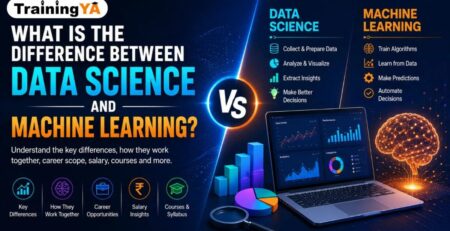
- Data Science is the broader field — involving data collection, cleaning, exploration, modeling, and communication of results.
- Machine Learning is a subfield — focused on predictive modeling using algorithms.
So, data science with machine learning is about turning data into insights through statistical techniques and automation — exactly what R was built for.
Professionals trained in R Analytics with Machine Learning can move into data science roles, leveraging both business understanding and analytical reasoning.

Real-Life Use Cases of R Analytics with Machine Learning
1. Marketing Analytics
Predict customer churn, segment audiences, and measure campaign effectiveness.
2. Financial Risk Analysis
Use regression and classification models to detect loan defaults or forecast credit scores.
3. HR Analytics
Predict employee turnover or recruitment success rates using historical data.
4. Healthcare Analytics
Analyze patient data to predict disease likelihood or treatment success.
These real-world projects make R Analytics with Machine Learning one of the most versatile career paths for non-tech professionals.
Must Read : Difference Between Artificial Intelligence, Machine Learning, and Deep Learning

Career Scope and Salary
The global demand for professionals skilled in analytics and machine learning is skyrocketing. According to Glassdoor and Naukri, the following average salaries are observed:
| Role | India Salary (₹ LPA) | US Salary (USD/year) |
| Data Analyst | 6–10 | 70,000–95,000 |
| Machine Learning Analyst | 8–14 | 90,000–120,000 |
| Data Scientist | 10–18 | 110,000–140,000 |
| Business Intelligence Analyst | 7–12 | 80,000–100,000 |
Professionals who transition from non-tech backgrounds typically experience salary jumps of 50–100% after acquiring skills in R Analytics with Machine Learning.
How to Start Learning R Analytics with Machine Learning
Here’s a roadmap for non-technical learners:
Step 1: Learn R Basics
Understand data types, loops, and basic commands.
Step 2: Explore Data Visualization
Learn to create charts and plots using ggplot2 or plotly.
Step 3: Understand Statistics
Learn mean, median, correlation, regression, and probability.
Step 4: Learn Machine Learning Algorithms
Work on linear regression, decision trees, and clustering models using the caret library.
Step 5: Practice with Real Projects
Apply concepts on datasets from Kaggle or UCI Repository.
Step 6: Create a Portfolio
Build dashboards or predictive models and showcase them on GitHub or LinkedIn.
By following this roadmap, non-tech professionals can seamlessly transition into analytics roles within 6–9 months of consistent learning.
How TrainingYA Supports Non-Tech Professionals
At TrainingYA, our specialized course in R Analytics with Machine Learning is tailored for learners from non-technical backgrounds.
We focus on:
- Hands-on learning through real-world datasets
- Step-by-step coding assistance
- Industry-relevant projects
- Placement assistance for analytics and data science roles
Our course bridges the gap between theory and practice, ensuring you gain the confidence to apply data analytics with R machine learning in real work environments.
Future of R Analytics with Machine Learning
As businesses continue to embrace AI, automation, and analytics, R remains a critical tool in data science. Its rich visualization and statistical modeling ecosystem make it a mainstay in industries like healthcare, finance, and academia.
The integration of R Analytics with Machine Learning allows organizations to:
- Automate decision-making
- Forecast trends
- Personalize customer experiences
- Improve operational efficiency
Thus, for non-tech professionals, this field represents a future-proof career path.
Must Read : Top 15 Most Demanding Courses in Future
Conclusion
For non-tech professionals seeking a future-ready career path, R Analytics with Machine Learning offers the perfect entry point into data science.
It combines the analytical intuition you already possess with the technical power of machine learning — helping you switch careers confidently and successfully.
Whether you’re from finance, HR, marketing, or operations, mastering data analytics with R machine learning opens doors to global opportunities in AI, business intelligence, and predictive analytics.
The data revolution isn’t just for tech experts — with R, it’s for everyone.
Frequently Asked Questions
Yes, absolutely. With structured training in R Analytics with Machine Learning, even non-tech professionals can learn how to clean data, build models, and interpret insights without deep programming knowledge.
Yes. By learning R for analytics, visualization, and statistics, non-tech professionals can successfully transition into data analyst roles across industries.
Jobs include Data Analyst, Machine Learning Engineer, Business Intelligence Specialist, Data Scientist, and AI Analyst. Professionals trained in data analytics with R machine learning are eligible for these roles.
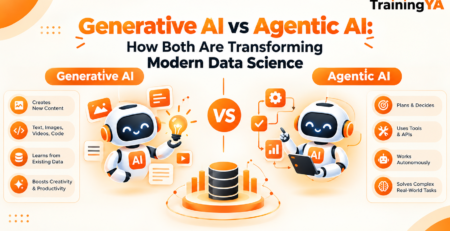
Machine learning focuses on learning patterns from data to make predictions. Generative AI, on the other hand, creates new data (like text, images, or code) based on learned patterns. Both are part of the data science with machine learning ecosystem.







Leave a Reply