
Is a Data Science with Generative AI course worth it in 2026?
By 2026, simply knowing Python, SQL, stats, and ML is not going to be sufficient for a data science career. You now need to be able to use LLMs, automate the analysis you do, assess AI-generated content and use those tools to make business decisions. The real question is: does a data science with generative AI course give you an actual advantage in 2026, or is a traditional data science course still sufficient?
A well-designed data science with generative AI course is a real opportunity for anyone who wants to get some hands-on experience in today’s data roles. Be very wary of courses that just teach you how to write prompts or are all about the cool tools. They don’t really add any value. The real value is in having AI integrated at every step of the data science process: data cleaning, data exploration, model building, result explanation and solution deployment. The aim is to enhance your core data science skills rather than simply replace them.
As data science matures, generative AI is becoming a core part of real-world workflows, and that’s highlighting both the most in-demand skills and the new risks. If you’re a fresh graduate, a seasoned professional, a career changer or a self-taught individual, taking a data science and AI course in 2026 is a sensible thing to do.
The Current Landscape: Data Science Meets Generative AI
Data science has always been a process that takes you from data collection and validation through to analysis, feature engineering, model building, visualisation, communication and, in some cases, deployment to production. Generative AI doesn’t replace that workflow; it just changes the speed, scale and structure of it.
Demand for data scientists is very high. The U.S. BLS is forecasting a 35% increase in data scientist employment from 2025 to 2035 (24,800 jobs per year). There’s a clear trend of organisations using AI more and more in their operations, which is in turn increasing the demand for data scientists.
The WEF’s Future of Jobs Report 2025 also identifies AI and big data as the two fastest-growing skills and analytical thinking as the most in-demand of the core skills from employers. Two-thirds of employers plan to recruit people with specific AI skills, and 40% expect to reduce their workforce in areas where AI can be used to automate.
These trends indicate that data science roles are becoming more selective rather than vanishing. Employers still want specialists in data quality, statistical analysis, experimentation, understanding the limits of models and commercial awareness. AI is taking over the drudge work (the boilerplate coding, the basic documentation, the charting, the data summaries, the SQL), and that’s enabling the professionals to do the more interesting work.
What’s changing in data science?
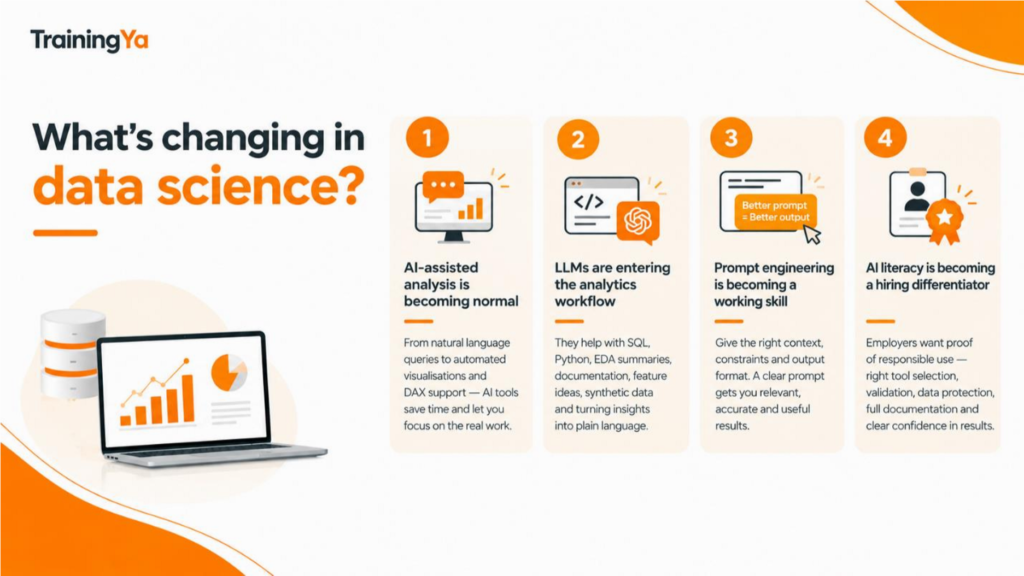
Generative AI is changing data science in four major ways.
1. AI-assisted analysis is becoming normal
Tools like Microsoft Copilot in Power BI enable you to query your data in natural language, generate insights, create visualisations and get help with DAX expressions. Microsoft describes Copilot for Power BI as a chat-based generative AI experience which can be used for ad hoc analysis by the business user as well as DAX generation for the more advanced user.
For data analysts, the tools save a huge amount of time on report writing and measure creation. The data scientists can spend more time on the problem definition, the validation of the results, the actual experimentation and supporting the decision-making rather than getting stuck in the implementation.
I am text block. Click edit button to change this text. Lorem ipsum dolor sit amet, consectetur adipiscing elit. Ut elit tellus, luctus nec ullamcorper mattis, pulvinar dapibus leo.
2. LLMs are entering the analytics workflow
LLMs are of use in the data science world where language, code and context all blend together. They can assist with writing or explaining SQL and Python code, summarising the EDA, writing up the documentation, suggesting approaches to feature engineering, generating synthetic test data and translating the findings for a non-technical audience.
Imagine a retail analyst using an LLM to generate a SQL query on customer repeat purchases. In that case, they’d still have to go through the joins, the date logic, the filters, the nulls and the business definitions. The AI would generate the query, but the analyst would still be responsible for its accuracy.
3. Prompt engineering is becoming a working skill
Prompt engineering for analysts is all about giving the AI sufficient commercial context, data definitions, constraints and output requirements to produce something useful. A good prompt will define the data set, the metric, the time period, the required output format, any assumptions you’d like to exclude and instructions as to how to deal with uncertainty.
A vague prompt like ‘Analyse this sales data’ is completely useless. A good prompt would be: ‘Given this monthly sales table, calculate the year-on-year growth by product category, exclude cancelled orders, treat returns as negative revenue and return a table with the category, current year revenue, prior year revenue, growth % and a brief explanation of the biggest movement.’
4. AI literacy is becoming a hiring differentiator
An AI certification is evidence that the data scientist has used AI in a responsible way (not just played with the tools). The hiring manager is looking for evidence of appropriate tool selection, validation of the output, data protection, full documentation and the ability to justify their confidence in the AIassisted result.
Is data science worth it in 2026?
Yes, data science is very much a thing in 2026. The definition of a good candidate has changed. Data science is still very much in demand in 2026. The benchmark for a good candidate has moved on, though. You now need someone who can take a business problem and solve it with data, who can use AI appropriately and who can be confident in the results they produce. The skills required are communication, logical thinking, mathematical ability and problem solving. The World Economic Forum also have data analysts and data scientists (along with AI and ML specialists) as one of the jobs that they expect to be growing through to 2030.
Demand is by no means even. If you’ve got nothing but a Python cert and a few projects you can’t really explain, then you’re going to find it very difficult to stand out. On the other hand, if you’re working with complex data, building solid models, able to communicate your work effectively and using generative AI to actually improve your productivity, then you’re going to be in very high demand.
Practical Impact on Professionals
Aspiring data scientists
For students and graduates, the Data Science with Generative AI course provides structure, mentorship, hands-on projects and a clear route from the theory to the point where you can actually go out and get a job. The course content generally follows the path of Python, SQL, stats, data cleaning, EDA, machine learning, visualisation and business.
Gen AI is a very useful tool, not a replacement for the fundamentals. If you’re using it to write code but you can’t debug, you can’t interpret the models, or you can’t explain your own metrics, then the interviews will very quickly reveal that.
Current data and technology professionals
For data analysts, software engineers and junior data scientists, the GenAI training delivers real benefits. They’re used to working with data, systems and business processes, so they can use GenAI to do a lot of the manual work and to solve a wider range of problems.
A Power BI analyst could certainly make use of Copilot in terms of getting reports and DAX created much more rapidly. They’d still need to have a very good grasp of data modelling, measure design and validation. Microsoft are very clear that the Copilot capabilities within Power BI are entirely reliant on the workspace and capacity that you’re using it in. You therefore also need to have a good understanding of the licensing, governance and deployment side of things.
Career switchers
For people in finance, ops, marketing, healthcare, sales and so on (i.e. non-technical people), data science is absolutely a career path you can go down if you have the relevant domain knowledge. Take the example of a former operations analyst. They don’t necessarily need to go and become a deep learning researcher. What they can do is take their existing experience and apply it to things like SQL, Python, Power BI, forecasting and AI-driven reporting.
The quickest route isn’t necessarily the best route. Career changers should be wary of courses that promise an instant mastery of AI and completely bypass the fundamentals of data, statistics and analysis.
Self-taught learners
Free resources are excellent for learning the basics of things like Python, SQL and stats, but they don’t really bring it all together. A paid data science with generative AI course is definitely worth it if it provides you with structure, project feedback, mentoring, interview prep and real accountability.
A certificate in itself will do nothing to impress an employer. What they’re looking for is the ability to talk about your projects, to justify your decisions and to demonstrate actual business impact. The certificate is secondary.
Business Implications for Employers
Organisations are using GenAI to bridge the gap between data and decisions rather than simply to cut jobs. Finance teams are able to do their variance analysis much faster. Marketing can get campaign summaries much quicker. Operations are using it to automate anomaly detection and to streamline their escalation reporting.
Generative AI can be used to increase throughput in these scenarios, provided the source data is of a good enough quality. If the source systems have problems (inconsistent product codes, duplicate records, poorly defined revenue, missing timestamps, etc.), then the AI-assisted reports will be faster to produce and will be of a much more polished appearance.
Real business value is derived from clean data, clear metrics, good models, human judgement and good governance. You need data professionals who understand analytics and the risks of AI rather than just people who know how to run the AI tools.
Technical Considerations: How to Use GenAI in Data Science
A full-fledged Data Science and AI curriculum should have Generative AI woven into the fabric of the entire analytical lifecycle.
- Data preparation: Use the LLMs to suggest the cleaning steps, to generate the documentation, to identify the data quality issues and to produce the transformation code. Validate each transformation against the source data.
- Exploratory data analysis: Use AI to generate hypotheses, summarise the distributions, produce the visualisation code and spot the patterns. Then go on to apply the appropriate statistical tests to confirm your findings.
- Feature engineering: use AI to generate the features and transformations, then evaluate the resulting features in terms of both effectiveness and interpretability.
- Model development: use AI to write the initial code, explain the algorithms, suggest the assessment criteria and document the experiments. We’ll of course maintain control over the train/test splits, data leakage and the hyperparameters.
- Retrieval-augmented generation (RAG) is how the LLM is connected to the organisation’s approved knowledge base, and that in turn reduces the amount of time it would otherwise have to spend mining information from its own general memory.
- Evaluation: use task-specific tests, human judgement, fact-checking, and error analysis. Don’t rely on instinct. Understand the APIs, the cost, the latency, the versioning, the monitoring and the logging and what your fallback is going to be if the AI component fails.
The smart thing to do is to use generative AI for the initial ideation and first draft stage, then subject everything to a rigorous critical review. Don’t let AI be the final word on any business-critical decision.
Risks, Limitations, and Governance
Generative AI carries several risks. NIST’s Generative AI Profile identifies confabulation (generating plausible but incorrect output), data privacy exposure, harmful bias, IP issues, and security risks (prompt injection and data poisoning, to name just two).
In data science, these are all very real risks. The model could invent column names, misinterpret a join, or offer a statistically plausible but wrong explanation of a phenomenon. Putting sensitive data into an unauthorised tool can expose it. An AI-generated dashboard narrative could be very convincing yet completely wrong.
Professionals should therefore learn basic AI governance practices:
- Never send any persona, never send any PII, never send any financial information, never send any medical information or any other kind of proprietary data to any unapproved AI tools.
- Keep a human review stage for insights, code, models and any customer-facing output.
- Document when and how AI was used in the analysis.
- Use the approved enterprise tools and access controls where these are available.
- Test any AI output against known examples before you trust it in production.
- Separate the AI-generated drafts from the real analysis.
Any data science with generative AI course that doesn’t cover these topics is fundamentally flawed.
Responsible AI isn’t optional at all; it’s absolutely essential if you want to be a competent professional.
Skills Professionals Should Develop in 2026
The most convincing profile is not simply that of a ‘data scientist’ or an ‘AI prompt engineer’. It’s a data professional who is technically sound and who can use AI as a tool to be more productive.
- SQL and relational data modelling for reliable data access and metric definitions.
- Python for data munging, automation, machine learning and AI integration.
- Statistics and experimental design if you’re actually going to draw any valid conclusions at all.
- Machine learning basics: supervised and unsupervised learning, evaluation and interpretation.
- Data visualisation and storytelling using Power BI, Tableau and the various Python libraries.
- Prompt engineering for data work (context setting, constraints, iterative refinement, output validation).
- LLM concepts: tokens, embeddings, RAG, vector databases, fine tuning v/s prompting, model evaluation.
- MLOps awareness (reproducibility, version control, monitoring, deployment, cost)
- AI governance, privacy, security, bias detection and documentation.
For a lot of jobs, skills in Power BI, SQL, Excel and business communication are just as important as having a deep understanding of AI. The real differentiator is the person who can take the AI-powered analysis and turn it into clear, actionable advice rather than the person who builds the most complex model that nobody can possibly understand.
How to Evaluate a Data Science with Generative AI Course
Before you sign up, judge the course on what it actually delivers rather than the marketing. Make sure it’s got some real problem-solving in it and that it actually enables you to build projects that you can go to an employer and say, “I’ve built this”.
- Does it cover Python, SQL, statistics, machine learning and data visualisation before moving on to generative AI?
- Does it have real datasets, real business case studies and actual end-to-end projects rather than just a series of guided exercises?
- Does it teach prompt engineering in a proper professional sense (i.e. validation and documentation)?
- Does it cover LLMs, RAG, embeddings, evaluation and responsible AI (not just chatbot use)?
- Does it have version control, deployment awareness and model/pipeline monitoring?
- Does it provide mentoring, help with any issues or concerns, mock interviews, portfolio advice and career advice?
- Can you speak to any alumni? Can you send us some project examples prior to us committing to pay?
- Does the institute reject the unattainable promise of work or the unattainable promise of a particular salary?
A good course should get you to the point of being able to deliver 3 to 5 projects that you can actually put in your portfolio. That would be a SQL and Power BI dashboard, a full machine learning pipeline, a GenAI analytics project and a responsible AI or RAG-based evaluation.
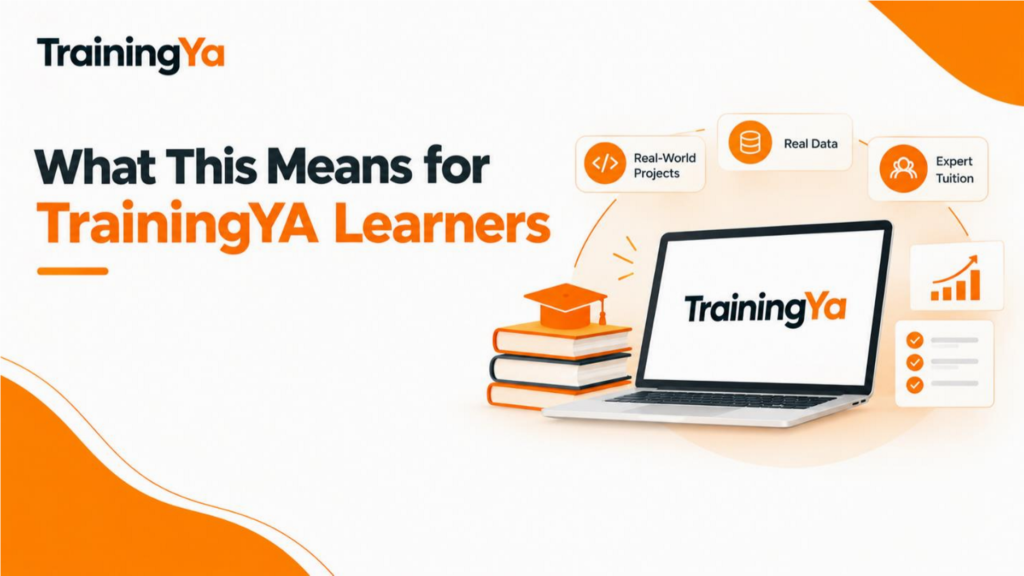
What This Means for TrainingYA Learners
For anyone looking at TrainingYA, the big question is: does it deliver a complete skill set? The TrainingYA
Data Science and Machine Learning course is very much focused on real-world applications, real projects, real data and expert tuition. It covers Python, data manipulation, data visualisation, supervised and unsupervised machine learning and model evaluation.
TrainingYA also have their 360° Data Science and AI programme, which is an end-to-end learning experience covering stats, Python, machine learning, deep learning, AI, NLP, cloud, big data, domain applications, capstone projects and professional development. It’s a properly structured, mentored, project-based approach which is far more effective than just ploughing through a bunch of individual tutorials.
Treat any structured program as your launchpad rather than a substitute for actual practice. Get the projects finished, rebuild at least one from scratch, get your work out there, keep practising explaining your decisions and keep your portfolio alive as AI continues to evolve.
Frequently Asked Question
Yes, if it’s got the core data science fundamentals as well as the practical generative AI skills. Not at all valuable if it’s just about prompt engineering and using the tools with no SQL, no Python, no stats, no ML, no data modelling and no business communication.
AI is far more likely to automate certain parts of data science than to take on the whole role. It can speed up the coding, the report writing, the documentation and the basic visualisation. The actual problem framing, the data validation, the model governance, the business communication and the application of business judgement are all things that will remain firmly in the human domain.
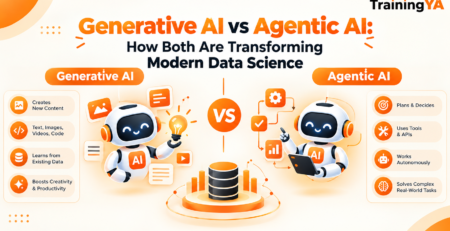
Generative AI in the data science context is about using generative models (specifically LLMs) to generate or augment text, code, summaries, explanations, synthetic examples and analytical workflows. That could be writing SQL, writing an explanation of some Python code, summarising an EDA, writing a report narrative and, in the case of RAG systems, providing the content to the system.
You don’t need to build the foundational models yourself; you just need to know how to use the LLMs safely and effectively. By 2026, AI literacy will be a key differentiator in the profession, particularly in the areas of analytics, reporting, automation and ML.
A cert in itself doesn’t improve your profile. What employers are looking for is evidence of your ability to do the job. That’s going to be in the form of well-documented relevant projects, technical ability and the ability to explain your thinking in an interview.
Start with the basics of data science (spreadsheets, SQL, Python, statistics, data cleaning, visualisation and basic ML). Then build on that with generative AI to boost productivity and analytical power.
Prompt engineering for business analysts is about giving the AI a clear commercial context, precise definitions of the data, the constraints and the required output. It’s about iterating the prompt and checking that the output from the AI is correct and appropriate.
LLMs can be useful as assistants but are not a source of truth in any way. They can get the answer wrong, they can misread the context, and they can leak. Human validation and human governance are absolutely essential.






Leave a Reply