
How AI Agents Are Changing the Future of Data Science in 2026
The Bottleneck in Modern Data Teams and the Agentic Era
For over ten years enterprise data teams have had to cope with a bottleneck caused by manual execution. Data engineers, data analysts, business analysts and machine learning professionals have on numerous occasions spent between 70 per cent and 80 per cent of their working time on operationally focused activities such as cleaning dirty schemas, debugging SQL queries, handling incompatible datasets, carrying out repetitive exploratory data analysis (EDA), and having to manually refresh business intelligence dashboards. When the first generative AI tools emerged in 2023 and 2024, they generally functioned as reactive copilots. Even though they were useful for generating individual code snippets or answering simple queries, these early LLMs required constant human supervision, the continuous pasting of context, and manual trial-and-error debugging every time an execution error occurred.
By 2026 a major change had occurred in the field of enterprise analytics. Rather than using passive AI chatbots that work on the basis of prompts, we have now switched to autonomous AI agents in the area of data science. These advanced agentic systems don’t just offer suggested code; they can understand complex data domains, maintain a persistent operational memory, formulate multi-step analytical plans, make use of a variety of dynamic tools available in cloud data warehouses, instantly correct any syntax or logical errors, and generate business insights at an executive level all requiring only a small amount of transactional human oversight.
At the current time, this is of great importance because the volume of data, the speed at which queries are made, and the degree of business complexity have gone beyond what people working alone are able to manage. The enterprise adoption figures for 2026 indicate that over 40% of enterprise software applications have embedded, task-specific AI agents and that 62% of organisations are already applying agentic workflows across their main functions. For technical professionals, working analysts, Power BI developers, and data leaders, this advancement has an effect on their careers. The primary value of a data professional is now not determined by how quickly they can write raw SQL queries or produce simple visualization widgets, but instead by their capacity to coordinate multi-agent analytics systems, take into account commercial context, keep statistical rigour, and supervise the autonomous AI tools used for data analysis.
After you have studied this tactical guide, you will clearly understand the technical manner in which autonomous data analysis works in 2026, why agentic AI in the area of data science is altering traditional workflows, the architectural and governance concessions that enterprise teams are obliged to make, the particular skills required if you are to remain indispensable, and how to place your career or team in a position to secure the greatest possible advantage within this new paradigm.
The Evolution of Analytics: From Passive Copilots to Autonomous AI Agents in 2026
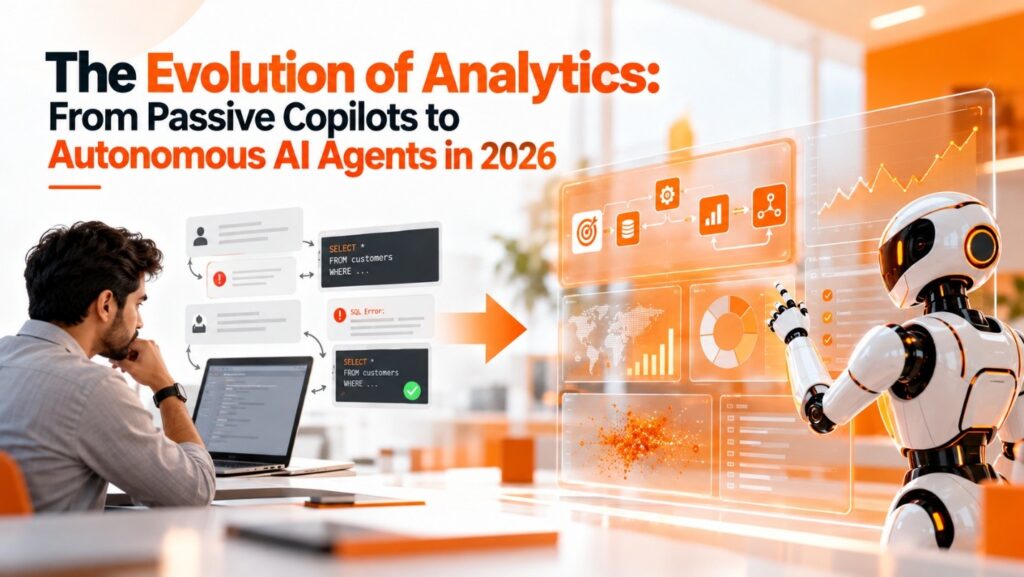
If we are to understand why AI agents in 2026 mark a major advance rather than merely a small improvement, a comparison between the earlier copilot model and the current agentic architectures is necessary. The initial generation of AI-based data science relied on stateless, one-off interactions. The way this worked was that the analyst would provide the LLM with a schema, request that it generate a SQL query, paste the query into a database editor, come upon a runtime syntax error or a missing join condition, copy the error message back into the chatbot, and then had to manually retest the solution. The whole of this process remained completely human-directed and transactional.
On the contrary, agentic AI in the field of data science operates through an autonomous loop that is aimed at achieving a goal. Rather than being given step-by-step instructions, the AI agent is assigned a high-level objective—for example, ‘Determine the root causes of the 14% quarter-over-quarter churn rate in the enterprise SaaS segment and produce a validated diagnostic report’. In order to achieve this objective, the agent makes use of four fundamental capabilities which define modern AI agents in data science.
- Multi-Step Planning and Decomposition: The agent breaks down a complicated business objective into a number of sub-tasks, such as schema inspection, feature correlation, cohort segmentation, hypothesis testing, and dynamic query execution.
- Dynamic Tool Calling and Context Protocols: Agents can check out data warehouses such as Snowflake, BigQuery, and Databricks, carry out dbt transformations, use the Python statistical libraries, and query vector databases which contain business metadata.
- In regards to the persistent state and long-context memory, agents maintain their context during analytical operations which last for several hours, keeping an eye on the hypotheses that have been tested, the failed query iterations, and the intermediate statistical findings without losing coherence.
- If a SQL query fails or if a model tuning step leads to low validation scores, the agent examines the execution log, identifies the root cause (for example, schema drift or collinearity), modifies its approach, and then runs the pipeline itself once again.
Major Technical Developments: How Agentic AI Redefines the Data Science Lifecycle
In 2026 the application of self-governing AI agents has systematically reorganised all the stages involved in the end-to-end data lifecycle. The following presents a detailed technical examination of how agentic systems operate in the major areas of activity.
-
Pipeline Monitoring, Ingestion, and Automated Repair
In the past, data engineering teams spent a great deal of their time sorting out faulty data pipelines and dealing with schema drift. By 2026, pipeline triage agents act as continuous background monitors inside orchestrators such as Apache Airflow, Prefect, and dbt. When an upstream API changes the data type of a field or an ETL job fails due to null constraints, the triage agent automatically checks the error log, traces the column-level lineage from the upstream to the downstream parts, detects the transformation that is causing the issue, suggests a code patch in a temporary sandbox, carries out regression tests, and then submits a Pull Request that is ready for merging together with complete documentation. As a result, the mean-time-to-resolution (MTTR) drops from hours to minutes.
-
Autonomous Exploratory Data Analysis (EDA) and Feature Engineering
Traditional EDA requires the manual production of plots showing univariate distributions, correlation tables, and profiles of missing values. In contrast, AI agents employed for data analysis carry out the entire baseline phase in parallel. A system that makes use of agents can analyse millions of rows distributed across hundreds of tables in just a few seconds, automatically identifying nonlinear associations between variables, detecting subtle data skewness, highlighting outlier data points, and generating interaction terms that are relevant to the domain. Rather than replacing human curiosity, it provides data scientists with a rich collection of pre-validated features and an initial hypothesis matrix.
-
Agentic Machine Learning and Autonomous Model Generation
While traditional AutoML had focused completely on grid search and the optimisation of hyperparameters with the use of fixed datasets, AI agents in the field of machine learning carry out the entire conceptual modelling process. An ML agent forms hypothesis strategies according to business metrics, selects appropriate families of algorithms (ranging from XGBoost to neural architectures), performs cross-validation, checks for data leakage, examines the distributions of the residual errors, and prepares detailed model cards which contain information on feature significance, bias checks, and the various operational trade-offs.
-
Automated Business Intelligence and Dynamic Semantic Layer Querying
For business intelligence professionals and people who develop Power BI, agentic AI has altered the way in which individuals use static dashboards by enabling real-time, conversational exploration of the data. The agents connect directly with semantic models (for example, Power BI semantic models or dbt semantic layers) and transform the vague questions posed by executives—such as ‘Which customer segment was responsible for our revenue deviation in Europe last month?’—into precise DAX or SQL queries. The agent then queries the semantic layer, verifies that the business definitions (for instance, Net ARR when compared to Gross ARR) comply with the governance rules, produces interactive visual widgets immediately, and generates a short narrative explanation that highlights the key statistical factors.
Practical Impact on Professionals: From Code Execution to System Orchestration
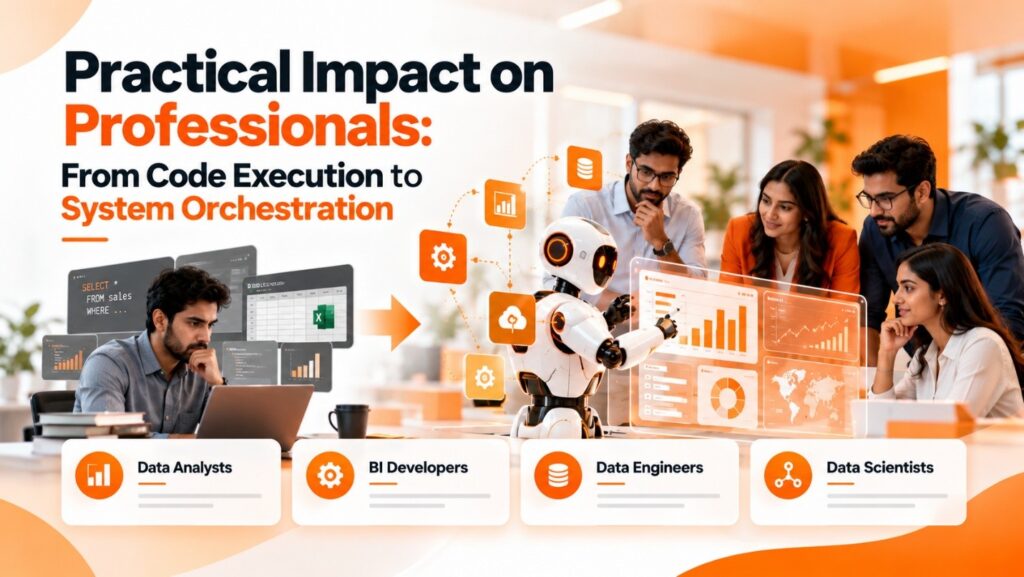
The greater the use of AI automation in the area of data science, the more it alters the principal responsibilities linked to different technical job roles. In order to remain competitive in 2026, professional analysts, developers, and team leaders need to understand this change.
For data engineers and business analysts the change means that they no longer need to draw up SQL queries by hand or alter Excel files, instead concentrating on context engineering, setting hypotheses and translating business decisions. Today analysts act in the role of domain directors by establishing the analytical boundaries, verifying that the conclusions reached by the agents are in line with how the business actually operates, and converting the intricate analytical data into enterprise strategies which can then be put into action.
For power BI developers and people working in the field of business intelligence, the emphasis shifts from manually dragging visual charts onto desktop canvases to instead focusing on building robust semantic layers, defining accurate business metrics, setting up data lineage, and configuring agentic interface endpoints. Then, business intelligence professionals become the architects of the enterprise’s knowledge layer and ensure that the AI tools employed by data engineers and business users query definitions which have been approved in accordance with governance standards.
For data engineers the focus moves away from having to deal with problems that occur in pipelines and instead involves setting up resilient data contracts, defining strict API endpoints, maintaining the vector metadata stores and implementing agent execution sandboxes. They ensure that the data infrastructure is just as accessible to agents and also secure.
For data scientists as well as machine learning engineers, their work has shifted from writing repetitive modelling scripts to designing multi-agent orchestration frameworks, establishing strict validation benchmarks, managing the fine-tuning pipelines for LLMS and SLMS, and auditing the outputs of self-driving systems with regard to bias, drift, and statistical validity.
Enterprise Business Implications: Speed, ROI, and Cost Dynamics
From the standpoint of corporate strategy, agentic AI in the area of data science leads to considerable monetary benefits but also introduces new operational trade-offs which business leaders will have to deal with carefully in 2026.
The biggest advantage is very rapid analytical processing; instead of the weeks-long co-ordination among a number of departments that was necessary in the past for diagnostic projects such as multi-touch marketing attribution, supply chain disruption modelling, or fraud network detection, these projects can now be completed in just a few hours. The speed at which insights can be gained allows businesses to react almost immediately to changes in the market, early indications of customer churn, and operational bottlenecks.
The approach that data science takes when dealing with economic issues is shifting from one that relies on fixed human operating expenses to one that is based on variable compute costs. Without proper management, the use of multi-agent orchestration pipelines involving millions of LLM tokens, vector embeddings, and real-time cloud data warehouse computing can cause API charges to rise rapidly. Because of this, companies are adopting hybrid architectures in which they use lightweight Small Language Models (SLMs) for normal tasks such as code generation and tool selection, and reserve the more expensive, reasoning-intensive core models for complex planning, multi-step reasoning, and the preparation of executive narratives.
Furthermore, enterprise governance is moving away from the ‘Human-in-the-Loop’ method—this involved humans having to approve each individual action carried out by intermediate tools—towards a ‘Human-on-the-Loop’ approach. In this more recent setup, autonomous agents continuously perform routine analytical background tasks, while human experts focus on handling edge cases, setting policy boundaries, carrying out periodic audit reviews, and giving their approval to major financial or operational decisions.
Technical Considerations: Architectural Requirements for Agentic Analytics
If autonomous AI agents are to be used, the data architecture of the enterprise data stack must be modernised. The organisations that successfully implement agentic AI in 2026 focus on three fundamental pillars:
In the first place, a solid semantic layer and a single, unified data catalogue should be established. Since the intelligence of the agents relies completely on the context they make use of, difficulties could arise if there is no clearly defined semantic layer—for example, the agent might confuse gross revenue with net revenue or fail to understand the definitions relating to the customer lifecycle. For this reason, companies must maintain centralised data catalogues—such as Microsoft Purview, Unity Catalogue, or Atlan—these containing complete metadata descriptions, business definitions, and column-level lineage so that the agents can navigate the data warehouse properly.
Second, the use of Standardised Tool Integration Procedures (Model Context Protocol). Rather than designing individual and fragile API wrappers for each database and tool, in 2026 enterprise teams make use of open standards such as the Model Context Protocol (MCP). The MCP provides a standard method by which AI agents can securely connect with relational databases, execution environments, instances, git version control systems, and internal documentation repositories without the need to hardcode the connection logic.
Third: Secure Execution Sandboxing and RBAC. Because AI agents need to be able to execute code dynamically, stringent security measures are still required. In production environments the agents run Python or R code within isolated containerised sandboxes (for instance, short-lived Docker containers or Web Assembly runtimes) so that the main IT infrastructure is not put at risk. Furthermore, the agents must inherit strict Role-Centric Access Control (RBAC) and attribute-level encryption rules in order to prevent unauthorised access to data or the exposure of sensitive customer PII.
Enterprise Risks, Limitations, and Governance Strategies
There have been considerable advances in agentic AI within the area of data science, but enterprise leaders and technical practitioners should nevertheless be fully conscious of the inherent limitations and operational risks involved.
- The fact that hallucinations occur together with the transmission of errors is that while it is not too difficult to detect hallucinations in one step, multi-agent systems are influenced by the buildup of error risks. If an agent wrongfully interprets the column schema in the first step, then this small error carries on into the feature engineering performed in the third step and eventually leads to completely invalid statistical conclusions in the fifth step. Therefore, strict intermediate validation checkpoints along with automated unit tests are essential.
- With regard to query execution, language models are by their nature probabilistic. An agent which is analysing a dataset on one day might generate a slightly different SQL query or feature transformation from the one it would generate on another day. But in the cases of financial compliance, regulatory reporting, and auditing, non-deterministic execution is not acceptable. It is therefore necessary for teams to enforce strict versioning of the agent’s prompts, the random seeds, the execution traces, and the generated SQL logs in order to ensure complete reproducible auditability.
- The expenses involved together with the waste of tokens are such that if an agent gets stuck in an infinite debugging loop attempting to correct an SQL error which has no solution, it could consume API tokens worth thousands of dollars in a short time. It follows that enterprise agent orchestration engines must have strictly enforced limits on the number of tool iterations, execution timeouts, and automatic alerts for sudden increases in token usage.
When it comes to data privacy and governance, it is necessary to ensure that when using autonomous data analysis tools care is taken to comply with data sovereignty laws (such as GDPR, CCPA and HIPAA). Sensitive data must be masked or anonymised before it is entered into the agent’s reasoning environment, and the agents must never send enterprise data to unexamined external model endpoints.
The 2026 Skill Matrix: What Data Professionals Must Learn Now
As AI tools continue to automate the execution of standard code and the production of simple dashboards, technical professionals will have to enhance their skills if they are to stay competitive. The following is the definitive capability matrix for the agentic era:
- It is necessary for professionals to have a good understanding of agent orchestration and to be familiar with a range of different frameworks (such as LangGraph, AutoGen, CrewAI, and DSPy); just as one needs to know Python or SQL, so too is it essential nowadays to know how to define agent roles, how to manage state, how to route tools, and how to set up evaluation benchmarks.
- Context engineering and metadata architecture: Prompt engineering has now developed into context engineering, and data experts need to acquire proficiency in organising schema metadata, business rules, semantic models, and vector documentation so that AI agents are given the best possible context in order to carry out their tasks accurately.
- Turning a domain and setting out the problem in a calculated manner: Although AI agents are capable of answering clearly defined questions, it is the responsibility of humans to formulate the appropriate strategic questions. The ability to convert vague business problems into precise and solvable analytical structures is a highly valuable part of human capability.
- As regards statistical rigour, validation, and code auditing, since the agents generate large quantities of code and statistical reports, the ability to carefully examine the agents’ output—identifying selection bias, confounding variables, data leakage, and logical flaws—becomes the most important criterion for quality control.
- The basic principles of data—those relating to Python, SQL, Power BI, and Tableau—remain essential, since you cannot carry out an audit of, or make corrections to, or add context to an AI agent’s SQL query or Power BI DAX code unless you yourself have a deep and fundamental understanding of SQL, Python, Power BI and data modelling.
Positioning Your Career for the Future: Strategic Guidance for TrainingYA Learners
People who want to ensure that their careers remain viable should adopt a purposeful and specific-to-the-industry method if they are to keep up with these technological developments. The training programmes in Data Analytics, Business Analytics, Power BI, SQL, Tableau, Python and Data Science offered by Trainingya are specifically designed so as to focus on practical and hands-on application rather than on conceptual theory.
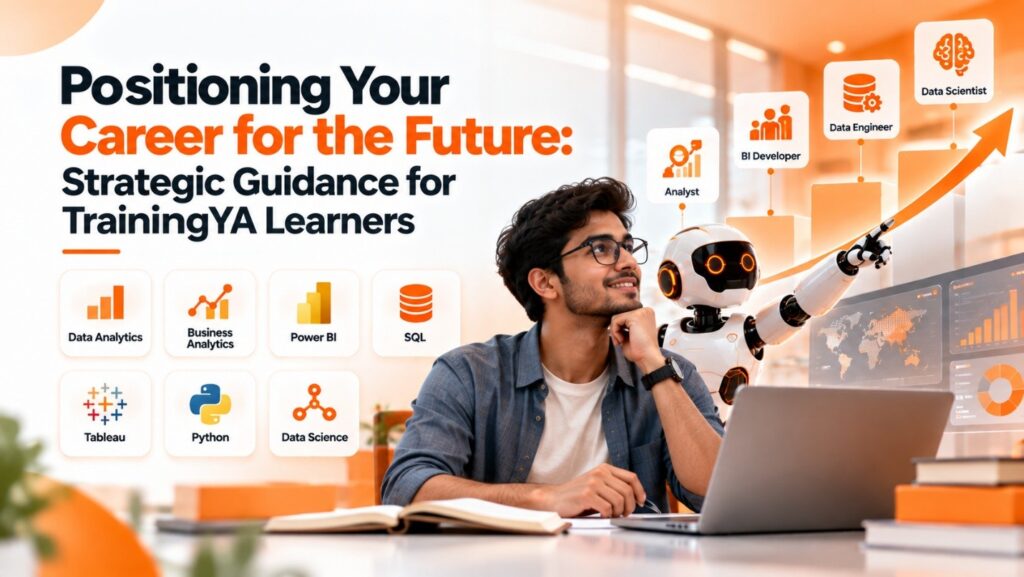
Rather than seeing traditional methods and AI automation as opposing forces, TrainingYA’s career-oriented course demonstrates that a strong knowledge of SQL, Python, and Power BI allows analysts to efficiently coordinate, verify, and steer AI-powered data science workflows. By focusing on practical project work and highlighting enterprise data architecture concepts, semantic modelling, and providing students with direct guidance from experienced professionals in the industry, they not only gain the deep technical skills required to build reliable data pipelines but also develop the practical flexibility needed to lead the deployment of agentic AI in today’s enterprise environments.
Frequently Asked Questions (FAQ)
AI agents are not going to replace data scientists or analysts but are instead changing the type of work that these professionals carry out. It is becoming more and more common to automate routine tasks such as drafting standard SQL code, carrying out simple data cleaning, and manually formatting charts. On the other hand, there is a rapid rise in the demand for people who can define strategic business problems, design semantic metadata layers, audit the logic used by agents, and convert complex analytical insights into recommendations about business decisions.
Generative AI copilots are reactive and can carry out only one-step operations, so the human user must continuously be involved by means of prompting, copying code, and manually performing the tasks. On the other hand, agentic AI in the area of data science is goal-directed and works autonomously because the agents are capable of planning out multi-step workflows, calling upon external database tools, keeping track of their state memory, reading the logs of any execution errors, and automatically correcting their code until the task assigned to them has been completed.
Python remains the primary language employed in the development of agentic AI; in 2026 the main orchestration frameworks are LangGraph, AutoGen, CrewAI, and DSPy. It is also necessary to understand standardised communication protocols such as the Model Context Protocol (MCP) and relational database query languages (SQL) if agents are to be connected to data infrastructure.
Enterprise agentic systems ensure security by operating within containerised sandboxes, making use of strict Role-Based Access Control (RBAC), and being connected through common semantic layers. When sensitive data is about to enter the model’s reasoning environments it is either masked or anonymised, and full audit records are maintained so that the queries can be verified deterministically.
Of course. By 2026 Power BI developers will be becoming increasingly involved in the creation of semantic models and data layers that serve both human business leaders and autonomous AI agents. Since BI developers understand how the agents query semantic models using DAX and SQL, they will then be able to design more valuable and interactive enterprise analytics architectures.
The Model Context Protocol (MCP) is an open-standard approach that provides a secure and unified means by which AI agents can connect to enterprise tools, databases, code repositories, and file systems. It eliminates the need for specially written and fragile integration code, enabling agents to safely query systems like Snowflake, BigQuery, or Databricks in a smooth way.
Organisations combat hallucinations by imposing strict semantic modelling constraints, carrying out deterministic unit tests on the code generated by agents, using retrieval-augmented generation (RAG) with respect to approved data catalogues, and including Human-on-the-Loop review checkpoints for any important analytical outputs.
Begin by reinforcing your core data foundations using SQL, Python, and data modelling. After that, look at how to organise schema metadata and semantic layers. Finally, gain some practical experience by working with Python agent frameworks such as LangGraph or CrewAI, building simple agents that call tools to automate regular exploratory analysis or the generation of SQL queries.








Leave a Reply