
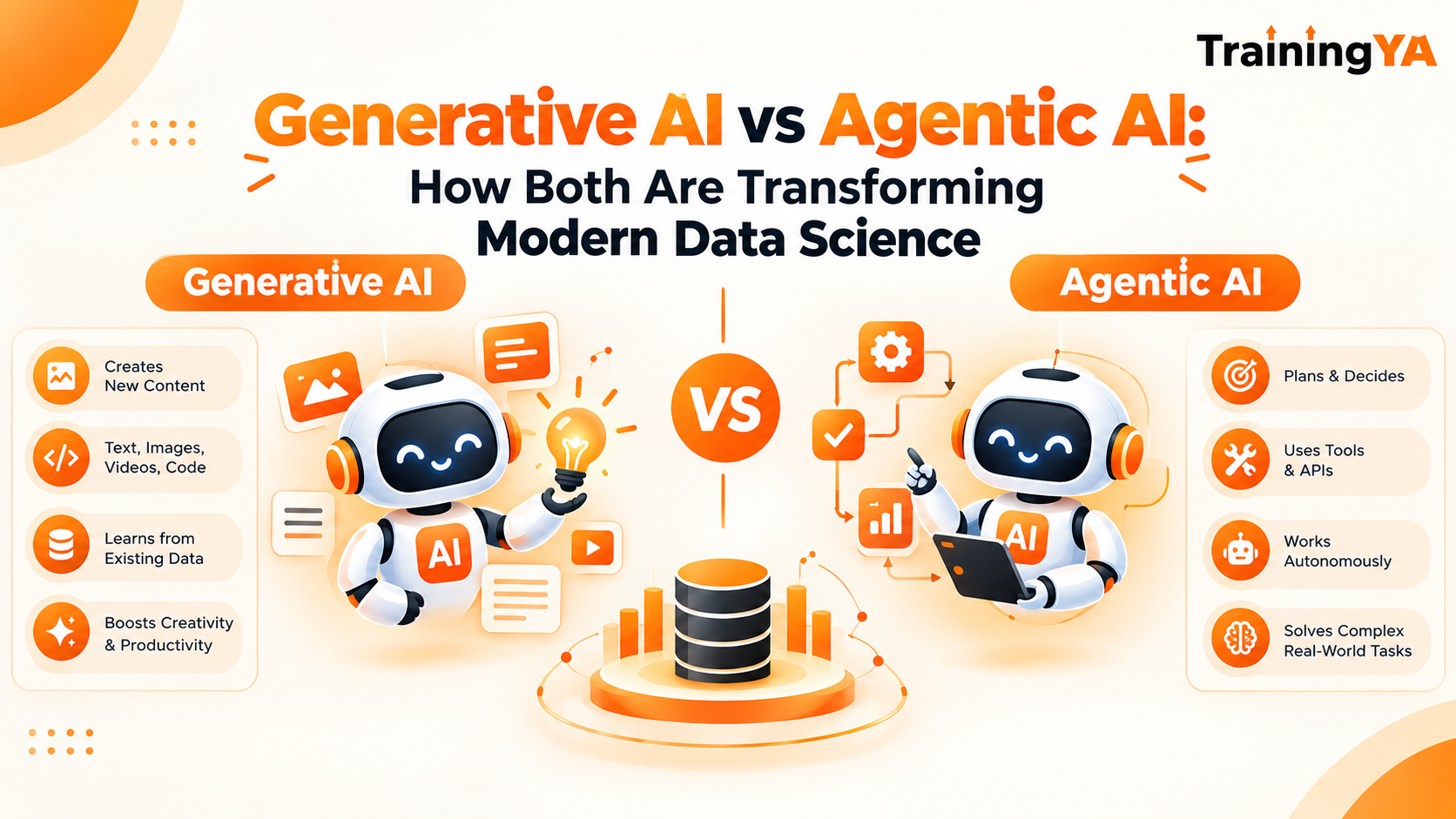
Generative AI vs Agentic AI: How Both Are Transforming Modern Data Science
Generative AI creates content, code, summaries, and analyses based on a prompt, while agentic AI goes a step further by combining models with tools, memory, planning, and feedback to handle complex, multi-step objectives. For data science professionals, the important point is not to choose between the two types but to use both of them to develop more robust, reliable and automated analytics workflows.
Introduction: Shifting from Content Generation to Taking Action
Generative AI (GenAI) has changed the way that data professionals use artificial intelligence. Nowadays, large language models are able to explain SQL, produce Python code, document models, summarize research, write data-cleaning scripts, and help analysts in sharing their insights. The fact remains that most interactions with GenAI still need human guidance for the next steps.
Agentic AI presents a new way of operating. Rather than ending once an answer is generated, an agent can plan tasks, choose suitable tools, carry out actions, check results, recover from errors, and keep going until the objective is achieved. This feature is especially useful for data science workflows which involve a number of interconnected steps.
What Is Generative AI?
Generative AI involves models that learn patterns from large datasets and produce new content in response to inputs or external stimuli. In the field of data science, this kind of content consists of Python or SQL code, technical documentation, explanations of statistical concepts, synthetic examples, summaries, instructions for visualisation, or structured outputs.
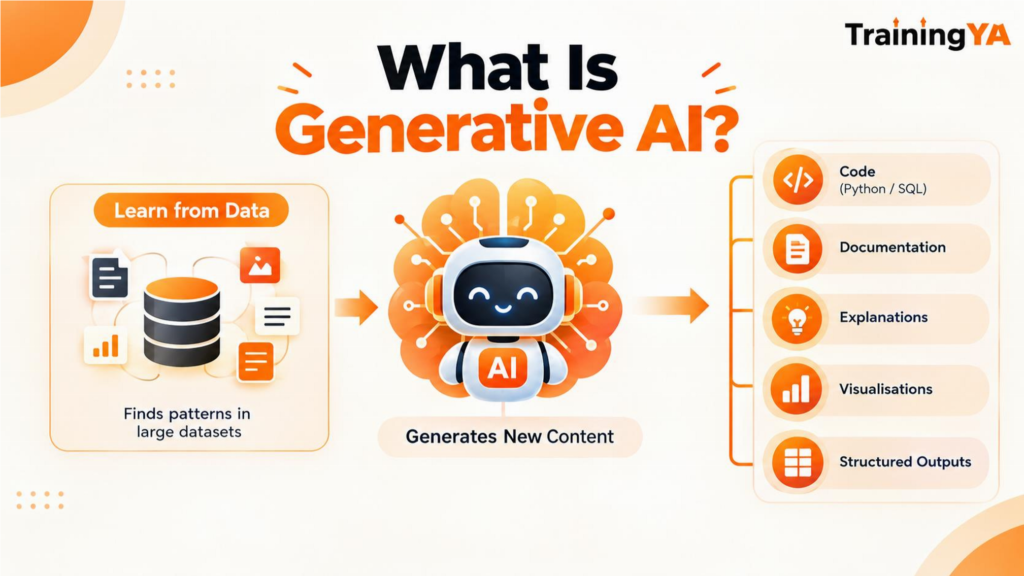
GenAI acts as an intelligent component that provides generation and assistance. For example, a data scientist might ask for a pandas workflow relating to the analysis of missing values, an explanation of model overfitting, or a conversion of the analysis into an executive summary. In the end, the human has to assess the output and decide on the next steps.
What is considered agentic AI?
Agentic AI refers to systems in which an AI model is incorporated into a wider workflow so as to carry out planning and take action in order to achieve specific goals. The kind of access that an agent is able to have will depend on its setting and may include SQL databases, Python environments, APIs, search systems, business applications, vector stores, or internal tools.
A data science agent could be given the job of working out why the weekly sales forecast had dropped. It might go through the most recent data, compare the distributions, examine the model metrics, identify any possible data drift, carry out the necessary diagnostics, produce a report, and then pass the results on to a human for approval. The extent of the freedom it has will vary according to the tools, permissions, evaluation methods, and guardrails established by the team.
GenAI vs Agentic AI: Key Differences
| Area | Generative AI | Agentic AI |
| Primary role | Generates content or responses | Pursues a goal through multiple actions |
| Interaction | Usually prompt- or conversation-driven | Goal- and workflow-driven |
| Tool use | May use tools when explicitly enabled | Designed around tool use and action loops |
| State | Often relies on conversation/context | Can maintain workflow state and memory |
| Execution | Typically suggests or generates steps | Can execute approved steps |
| Human role | Reviews and directs outputs | Defines goals, permissions, evaluations, and oversight |
| Typical data task | Generate SQL or explain an analysis | Run, inspect, revise, and document an analysis workflow |
Why Agentic AI is Important for Data Science
Data science almost never consists of just one separate task; instead, actual projects combine all the stages such as data discovery, schema validation, cleaning, feature engineering, exploration, experimentation, model evaluation, documentation, monitoring, and communication. Agentic systems are able to link the key parts of this complicated process.
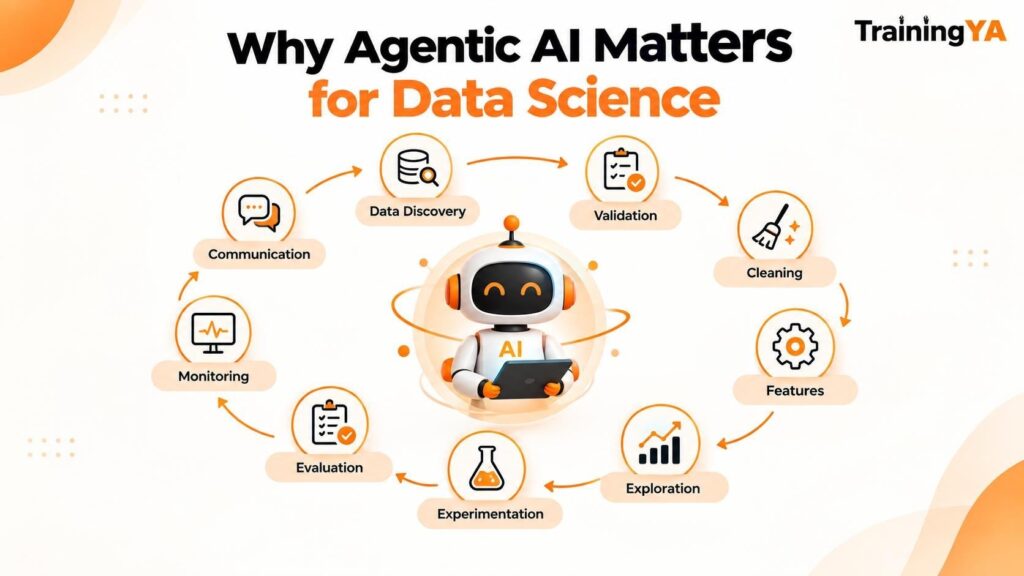
Agentic AI is well suited to such situations; in addition to generating code, it can coordinate a number of tools by looking at datasets, preparing queries, running Python in a secure environment, checking the results, and then producing summaries that are reproducible for human review.
Examples of the application of agentic AI in the field of data science
- An agent can have an EDA automated by having the automated EDA carry out profiling of the columns, the detection of missing values and unusual distributions, the generation of appropriate visualisations, and the summarising of the findings for review.
- If a quality check fails, an agent can look at recent records. They can compare schemas, find likely causes, and suggest a solution.
- Agents are able to diagnose failed jobs concerning ETL and pipeline support, check the logs, test suggested fixes in a secure environment, and produce change requests rather than making direct changes to production.
- A model is capable of carrying out experiments, which enables it to carry out controlled ones, compare the approved configurations, record the metrics, and summarise the results.
- Looking at anomalies: an agent can use SQL and Python analysis together with monitoring metrics in order to look at unusual changes in business or operational data.
- Once a workflow has been approved, the agent is able to produce technical notes which include details about the data sources, the assumptions, the transformations, the metrics, and the limitations.
- With natural-language analytics, business users are able to pose questions in ordinary language, after which an agent converts the approved requests into queries and analytical steps and then checks that the results are valid before releasing them.
Tools for data analysts and scientists and data scientists which are provided by AI Agents
- LangGraph and LangChain are useful for the creation of structured, stateful workflows which involve branching, tool calls, checkpoints, and human-in-the-loop patterns.
- CrewAI is designed with a focus on collaborative agent roles and can be of use in cases where a workflow is naturally divided into specialised responsibilities.
- Microsoft AutoGen enables the use of multi-agent application patterns and interactions between agents in complex workflows.
- The Python and SQL tool layers are generally more important than the agent framework itself since agents require controlled access to reliable analytical environments.
- Vector databases and retrieval systems are useful in cases where agents need direct access to internal documents, schemas, policies, or domain knowledge.
- Tools for evaluation and setting guards: Allow teams to test accuracy, tool behaviour, retrieval quality, safety, and failure modes before increasing autonomy.
LangGraph, CrewAI, and AutoGen: how should teams proceed?
No single framework fits all data science teams; focus on understanding your workflow rather than chasing the latest trends.
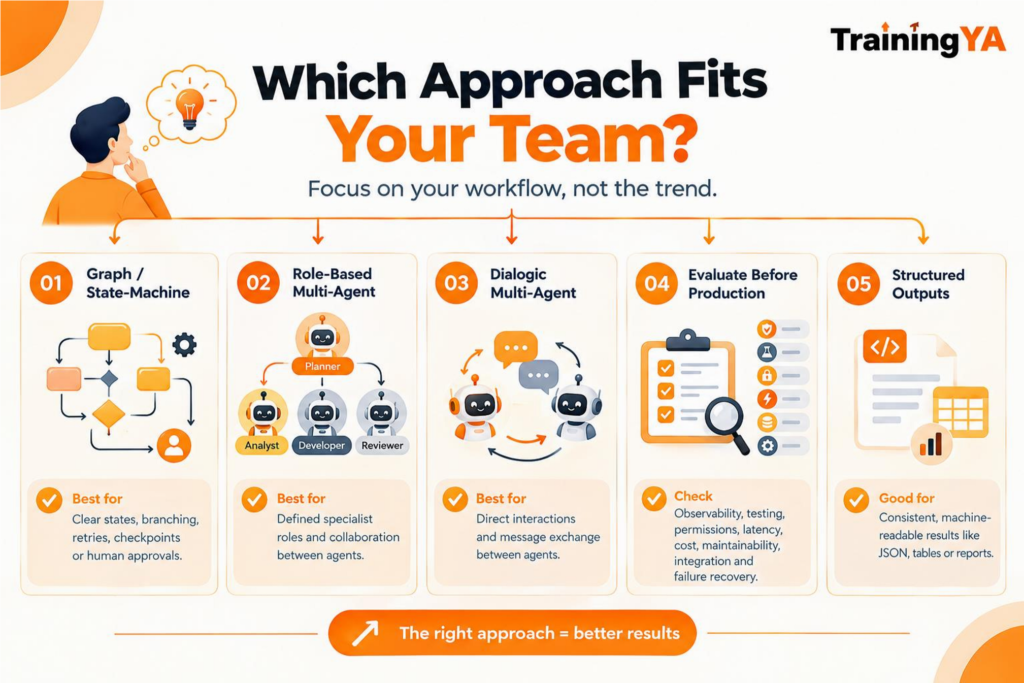
- Use a graph or state-machine approach if the workflow involves clear states, branching, retries, checkpoints, or human approvals.
- A role-based multi-agent approach should be chosen when the problem involves clearly defined specialist responsibilities and it is advantageous for the specialists to collaborate.
- When agents need to exchange messages or coordinate via direct interactions between agents, use a dialogic multi-agent approach.
- Before deploying to production, you should evaluate observability, testing, permissions, latency, cost, maintainability, integration effort, and failure recovery in all cases.
The Reason Why Data Scientists Need Both Generative AI and Agentic AI
GenAI and agentic AI can be seen as complementary layers; GenAI offers the abilities related to language and reasoning so that code can be generated, data interpreted, evidence summarized, and structured responses created. The agentic architecture, on the other hand, includes orchestration, access to tools, management of state, handling of permissions, the ability to provide feedback, and the capacity to take action.
For example, a generative AI could produce a Python analysis, after which an agentic workflow could safely carry out the code, check the results, ask for any necessary corrections and then prepare a report for review. Through this kind of collaboration, repetitive tasks are reduced while keeping humans accountable for important decisions.
The difficulties involved in implementation and typical mistakes
- The boundaries of autonomy are unclear: granting an agent wide powers without specifying what it is allowed and what it is not allowed to change can result in operational risk.
- A poor assessment is that a workflow which appears impressive during a demonstration might fail when faced with edge cases. Teams should use representative test sets and have measurable criteria for evaluation.
- There are problems relating to data quality in that an agent cannot consistently correct fundamentally wrong or incomplete source data unless appropriate validation rules are in place.
- There is the possibility of tools being used incorrectly, for example by choosing the wrong tool or by producing a query that is technically valid but unacceptable from a business point of view. It is important to have proper tool permissions and validation.
- There are gaps in observability: in order for production systems to function properly they need logs, traces, records of tool calls, and clear explanations for important actions.
- The cost and latency can increase due to multiple calls to the model and the execution of tools.
- Too much automation can be a problem. Some choices need expert knowledge or approval. Keep human checkpoints when the results matter a lot.
Security, Privacy, and Governance
Think of enterprise agentic systems as software platforms that have access to data and tools, not just as chatbots. Sensitive data should be protected by means such as authentication, authorisation, implementing the principle of least privilege, managing secrets, using encryption, maintaining logs, and establishing appropriate data retention policies.
People should specify what an agent is allowed to read, what it is allowed to write, what actions need approval, and how the outputs are to be audited. In regulated or sensitive environments, governance has to take into account the risks associated with the model, the need to track data lineage, privacy requirements, the risks of prompt and tool injection, and the response to incidents.
The future of data science skills
The future of data science skills does not end with coding; solid knowledge of statistics, machine learning, experimentation, SQL, Python, and data engineering is still necessary. What is becoming more important is combining these basic skills with AI-powered systems.
- Agent orchestration and workflow design
- Prompt engineering and structured outputs
- API integration and custom tool development
- Evaluation, testing, observability, and guardrails
- Retrieval-augmented generation and vector search
- Data governance, privacy, and AI security
- Human-in-the-loop system design
- Enterprise communication and domain understanding
A practical roadmap for upskilling data scientists
- The first step—consolidating the basics—is to maintain a strong command of SQL, Python, statistics, machine learning, data engineering, and experimentation.
- In step two you should learn the basics of generative AI: this involves understanding how large language models behave, the use of prompting, structured outputs, embeddings, retrieval, and the common ways in which they fail.
- Step 3 — Create workflows that involve using tools: connect the models to Python, SQL, APIs, and controlled datasets.
- In step 4 you should learn about orchestration: use an agent framework to create workflows incorporating state, branching, retries, approvals, and observability.
- In step 5, you should create tests covering accuracy, tool selection, groundedness, safety, latency, and cost.
- In step 6, when building portfolio projects, create projects such as an EDA agent, a data-quality investigator, a model experiment assistant, or an analytics copilot.
- In step 7 you should learn about enterprise practices by studying access control, privacy, monitoring, deployment, governance, and responsible AI.
Things to look for in an agentic AI course in Gurgaon
Anyone thinking about taking an agentic AI course in Gurgaon should go beyond simply looking at lists of tools; the most effective courses connect the concepts with practical projects and show how to build, assess, secure and deploy agentic workflows.
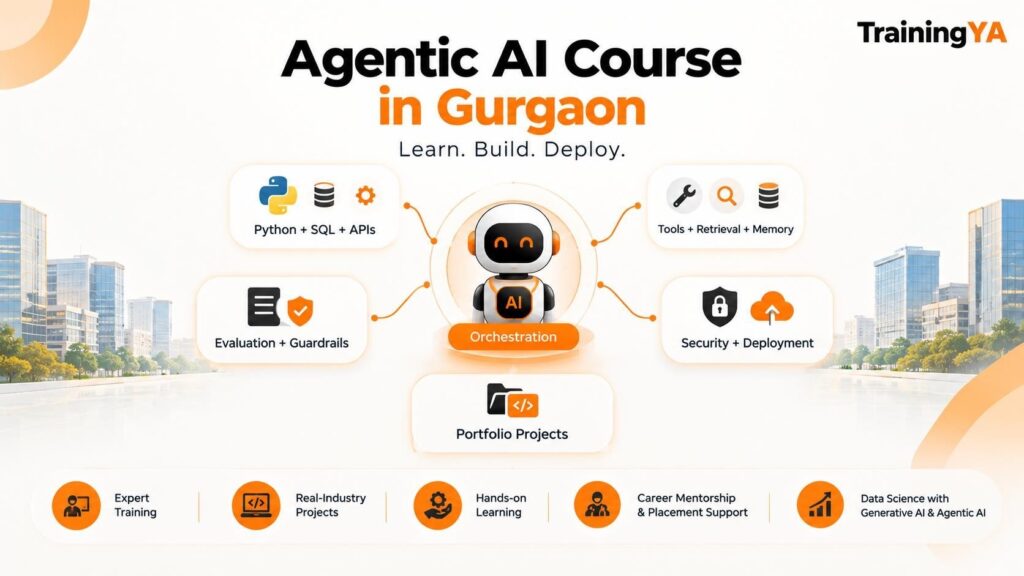
- Hands-on work with agent orchestration frameworks
- Projects involving Python, SQL, APIs, and real datasets
- Tool calling, retrieval, memory, and workflow state
- Evaluation and guardrail practices
- Enterprise security and deployment considerations
- Portfolio-ready projects and practical debugging
Frequently Asked Question
Generative AI primarily produces content or responses based on a given context, while agentic AI makes use of AI models as part of a goal-directed workflow that includes the ability to plan, employ tools, keep track of the state, evaluate the results at intermediate stages, and carry out approved actions.
While agentic AI is capable of automating some of the repetitive tasks involved in analytical work, data science still demands problem formulation, statistical judgment, an understanding of the domain, validation, experimentation, and responsible decision-making.
Common uses include automated EDA, data quality checks, pipeline diagnosis, model testing, anomaly checks, documentation, and natural language analytics.
Examples of useful technologies are agent orchestration frameworks, integrations with Python and SQL tools, retrieval systems, evaluation tools, and observability platforms, the appropriate mix of which will vary according to the workflow.
Begin by looking at the workflow architecture and the requirements it entails, and take into account issues such as state management, agent collaboration, tool integration, observability, testing, deployment, cost, and maintainability, not just relying on the popularity of the framework.
The usual difficulties include vague permissions, unreliable tool calls, inadequate evaluation, problems with data quality, security risks, poor observability, high costs, and too much autonomy.
Authentication, authorisation, least-privilege tools, controlled execution environments, encryption, audit records, data policies, approval gates, and monitoring can all be used. The specific controls had to correspond to the organisation’s security and compliance requirements.
In addition to core data science, professionals have the opportunity to develop their abilities in the areas of agent orchestration, APIs, tool calling, retrieval, evaluation, observability, AI security, and human-in-the-loop system design.
It is valuable to follow such a course provided that it involves practical projects, the use of up-to-date tools, real datasets, evaluation methods, and a focus on deployment, rather than offering merely conceptual teaching.







![Best Microsoft Power BI Courses & Certificates [2026]](https://www.trainingya.com/wp-content/uploads/2026/05/Learn-Python-in-2026-450x231.webp)

Leave a Reply