

How to Become a Data Scientist with Generative AI and Agentic AI Skills in 2026
Introduction
Data Science is currently one of the most popular and advanced career paths in the field of technology. However, as the industry advances, the role of a data scientist is changing quickly.
In the past, data scientists focused on tasks like data analysis, statistical modelling,
building machine learning models and creating data visualisations. Today, the field is changing quickly, with Generative and Agentic AI playing increasingly important roles in how data is analysed, interpreted, and used to make better decisions. As this trend continues, combining Data Science with Generative AI and Agentic AI is becoming a highly valuable career option in 2026 for those who want to stay at the cutting edge. This guide, written in clear and simple language, covers the following topics:
- What Data Science is
- What Generative AI is
- What Agentic AI is
- The Skills needed to become a Data Scientist
- A step-by-step learning plan
- Important tools and technologies
- Project ideas
- Career opportunities
- How to prepare for a Data Science career in 2026
| Area | What You Learn |
| Python | Programming and data processing |
| SQL | Working with databases |
| Statistics | Understanding data |
| Data Analysis | Finding patterns and trends |
| Data Visualization | Presenting data using charts |
| Machine Learning | Making predictions from data |
| Deep Learning | Working with advanced AI models |
| Generative AI | Building AI-powered solutions |
| Agentic AI | Creating AI systems that can perform tasks |
What Is Generative AI?
Generative AI is a type of artificial intelligence that can create fresh content.
For example, Generative AI can create:
- Text
- Computer code
- Images
- Summaries
- Reports
- Ideas
- Audio
- Video
AI chatbots and Large Language Models (LLMs) are common examples of Generative AI.
For Data Scientists, Generative AI can make many tasks easier.
For example, it can help with:
- Writing Python code
- Creating SQL queries
- Explaining code
- Summarizing data
- Creating reports
- Finding possible patterns
- Generating documentation
- Building AI applications
However, a Data Scientist still needs to check the results because AI can sometimes provide incorrect information.
What Is Agentic AI?
Agentic AI is a newer approach to artificial intelligence.
A traditional AI chatbot will respond to your input, which is given as a prompt.
As for AI agents, they may be designed to perform a series of tasks to achieve a goal.
For example, you put forth that you want:
Please review the sales statistics for this month and create a report.
An AI agent may also:
- Get the sales data.
- Clean the data.
- Analyze the numbers.
- Find important trends.
- Make charts.
- Write a summary.
- Prepare a report.
This makes Agentic AI especially useful for automation and business workflows.
Generative AI vs Agentic AI
| Generative AI | Agentic AI |
| Generates content | Performs tasks |
| Responds to prompts | Works toward a goal |
| Can generate code or text | Can use tools and systems |
| Mainly focuses on content generation | Focuses on completing workflows |
| Example: Generate a SQL query | Example: Run the query and analyze the result |
Why Should Data Scientists Learn Generative AI and Agentic AI?
Data Science is becoming increasingly connected to artificial intelligence.
Companies are using AI to automate repetitive tasks, analyse information, build applications, and improve decision-making.
After learning, Generative AI and Agentic AI can help Data Scientists:
- Work faster
- Automate repetitive work
- Build AI-powered applications
- Analyse information more efficiently
- Create intelligent workflows
- Work with Large Language Models
- Build AI agents
- Solve more complex business problems
But there is one important thing to remember:
AI skills should add to your Data Science knowledge, not replace it.
You still need to understand data, statistics, programming, and machine learning.
How to Become a Data Scientist with Generative AI and Agentic AI Skills
If you are a beginner, you do not need to learn everything at once.
Follow this step-by-step roadmap.
Step 1: Learn Python
Python is the main language in the field of Data Science and AI.
Start with basic Python concepts such as:
- Variables
- Data types
- Conditions
- Loops
- Functions
- Lists and dictionaries
- Classes and objects
- File handling
- APIs
After learning the basics, learn popular Python libraries such as:
- NumPy
- Pandas
- Matplotlib
- Seaborn
Read for More Information: Python Developer Roadmap for Beginners in 2026
Why Python?
Python is easy to learn and has many libraries for Data Science, Machine Learning, and AI.
Step 2: Learn SQL
SQL is another important skill for Data Scientists.
Most companies store their business data in databases. SQL helps you get and analyse that data.
You should learn:
- SELECT
- WHERE
- GROUP BY
- ORDER BY
- JOIN
- Subqueries
- CTEs
- Window Functions
- Aggregations
Example
A company that has millions of customer records uses SQL to determine:
“Which products generated the highest sales last month?”
This is why SQL is an important part of a Data Science learning path.
Step 3: Learn Statistics
Statistics will help you to interpret data well. Also, you should study the basics, which include:
- Mean
- Median
- Mode
- Probability
- Standard deviation
- Variance
- Correlation
- Regression
- Hypothesis testing
- Probability distributions
At the start, you don’t need to know advanced math. Put your energy into learning which stats concepts to apply.
Step 4: Learn Data Analysis
Before building complicated AI models, learn how to understand data.
A Data Scientist should know how to:
- Clean data
- Remove duplicate information
- Handle missing values
- Find unusual data
- Identify patterns
- Compare different variables
- Create charts
- Explain findings
Tools such as Pandas, Matplotlib, Seaborn, Power BI, and Tableau can help at this stage.
Step 5: Learn Machine Learning
A key component of data science is machine learning
Machine learning enables computers to see patterns in data and make predictions.
Start with algorithms such as:
- Linear Regression
- Logistic Regression
- Decision Trees
- Random Forest
- K-Means
- Support Vector Machines
- Gradient Boosting
You should also understand:
- Training data
- Testing data
- Features
- Model evaluation
- Overfitting
- Underfitting
- Cross-validation
Step 6: Learn Deep Learning
You can progress to Deep Learning once you have mastered Machine Learning.
Deep Learning solves complex issues using neural networks.
Learn the basics of:
- Neural Networks
- Activation Functions
- Backpropagation
- Optimization
- CNNs
- RNNs
- Transformers
Transformers are especially important for understanding modern Generative AI and large language models.
Step 7: Learn Generative AI
Now you can start learning Generative AI.
Some important topics include:
| Topic | What It Means |
| LLMs | AI models that understand and generate text |
| Prompt Engineering | Writing better instructions for AI |
| Embeddings | Representing information as numbers |
| Vector Databases | Storing and searching embeddings |
| RAG | Giving AI additional information to answer questions |
| AI APIs | Connecting AI models to applications |
| Fine-Tuning | Adapting models for specific tasks |
| Model Evaluation | Checking how well an AI system performs |
Start with simple projects instead of trying to build a large AI system immediately.
Step 8: Learn RAG
RAG stands for Retrieval-Augmented Generation.
It allows an AI application to retrieve information from a specific knowledge source before generating an answer.
For example, a company could build a chatbot that answers questions using its own:
- Documents
- Training material
- Product information
- Policies
- Reports
This is useful because the AI can use information from a specific knowledge base instead of relying only on its general training.
RAG is an important concept for people learning modern Generative AI applications.
Step 9: Learn Agentic AI
Once you understand Generative AI, you can start learning Agentic AI.
Important concepts include:
- AI Agents
- Tools
- Function Calling
- Planning
- Memory
- Workflows
- Retrieval
- Multi-Agent Systems
- Human-in-the-Loop
- Agent Evaluation
The goal is to understand how AI can do more than simply generate an answer.
It can be designed to perform actions and complete workflows.
Step 10: Build Real-World Projects
Projects are one of the best ways to learn Data Science and AI.
Instead of just watching videos or finishing tutorials, build projects that address real problems.
Data Science + Generative AI Project Ideas
| Project | What It Does |
| AI Data Analyst | Answers questions about datasets |
| Sales Forecasting System | Predicts future sales |
| Customer Analysis Agent | Analyzes customer behavior |
| AI Report Generator | Creates reports from data |
| RAG Chatbot | Answers questions from documents |
| Resume Analyzer | Analyses resumes using AI |
| Financial Data Assistant | Explains financial datasets |
| Marketing Analytics Agent | Analyses marketing performance |
They offer you the opportunity to create a solid portfolio.
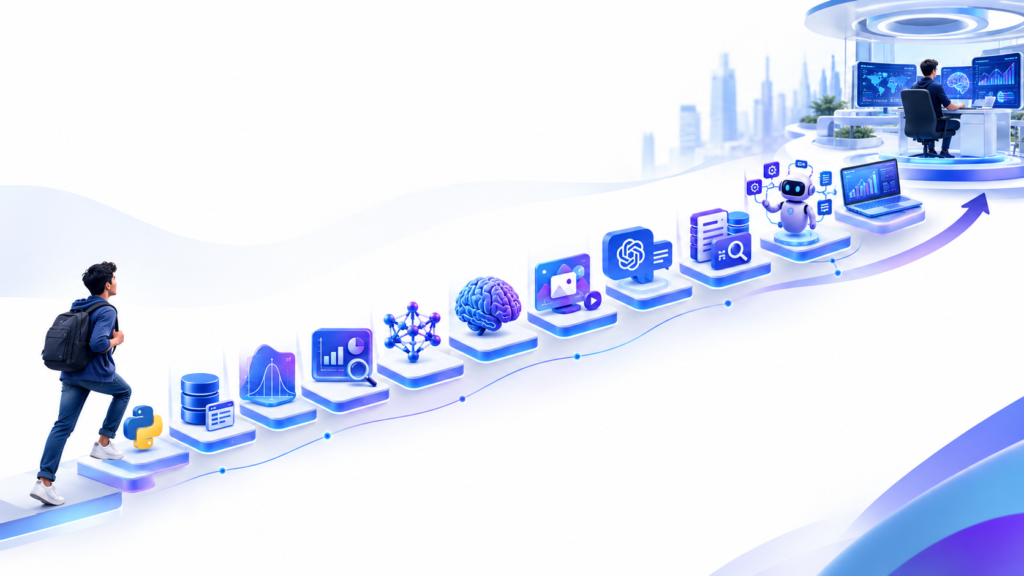
Data Science with Generative AI and Agentic AI Roadmap
Here is an easy roadmap you can follow:
| Stage | Skills |
| Stage 1 | Python |
| Stage 2 | SQL |
| Stage 3 | Statistics |
| Stage 4 | Data Analysis |
| Stage 5 | Data Visualization |
| Stage 6 | Machine Learning |
| Stage 7 | Deep Learning |
| Stage 8 | Generative AI |
| Stage 9 | LLMs and RAG |
| Stage 10 | Agentic AI |
| Stage 11 | Real-world Projects |
| Stage 12 | Portfolio and Interview Preparation |
This roadmap gives you a clear path from beginner-level Data Science to modern AI skills.
Important Skills for a Data Scientist in 2026
A modern Data Scientist needs both technical and non-technical skills.
Technical Skills
| Skill | Importance |
| Python | Very High |
| SQL | Very High |
| Statistics | High |
| Data Analysis | Very High |
| Machine Learning | Very High |
| Deep Learning | High |
| Generative AI | Very High |
| RAG | High |
| Agentic AI | High |
| Cloud | Useful |
| Git/GitHub | Useful |
Soft Skills
You should also work on some important skills that will help you in your career, such as:
- Problem-solving
- Communication
- Critical thinking
- Business understanding
- Teamwork
- Presentation skills
- Decision-making
A good Data Scientist must not only understand data and technology but also be able to explain their findings in simple terms so that other people can understand and make use of them.
Career Opportunities in Data Science and AI
Learning both Data Science and Generative AI, as well as Agentic AI, can help you explore a variety of technology roles.
| Job Role | Main Work |
| Data Scientist | Analyze data and build predictive models |
| Data Analyst | Analyze and report business data |
| Machine Learning Engineer | Build and deploy ML models |
| AI Engineer | Build AI-powered applications |
| Generative AI Engineer | Build applications using Generative AI |
| AI Agent Developer | Build AI agents and workflows |
| ML Analyst | Work with machine learning and data |
| Applied AI Engineer | Apply AI to real-world problems |
Your exact job role will depend on your skills, experience, projects, and the requirements of the company.
How long does it take to learn data science
using Generative AI?
There is no set time since each person learns at a different speed.
A beginner who studies consistently can follow a learning plan like this:
| Learning Period | Focus |
| Months 1–2 | Python + SQL |
| Months 2–3 | Statistics + Data Analysis |
| Months 3–5 | Machine Learning |
| Months 5–6 | Deep Learning |
| Months 6–8 | Generative AI + LLMs |
| Months 8–10 | RAG + Agentic AI |
| Months 10+ | Advanced Projects + Portfolio |
The timeline is only an example.
Your goal should not be to finish quickly. Your goal should be to understand the concepts and build useful projects.
How to Get a Data Scientist Job in 2026
It’s great to learn Data Science, but that isn’t the only thing you need to do if you want a job. Moreover, you’ll have to show companies that you can apply your skills to real-world problems. The following are the steps you can take to increase your chances of securing a Data Scientist position.
-
Create a GitHub Portfolio
Set up a GitHub account and include the Data Science, Machine Learning, and AI projects that you have worked on. The GitHub account acts as a portfolio which hiring managers consult in order to look at your work rather than just the skills listed in your resume.
-
Work on Real Projects
Choose in-depth projects rather than simple ones, and one way to do this is by using online tutorials. Instead, select projects that involve real-world problems, for example, by examining sales data, carrying out customer segmentation, and creating a recommendation engine—projects that are of a business type. These projects also provide a good opportunity to gain practical experience and to enhance your portfolio. Make sure you can explain your projects as well.
-
Learn to Explain Your Projects
Be ready to explain:
- What issue did you solve?
- What data did you use?
- Which tools did you use?
- Why did you go with a certain model?
- What were the results?
- How would you improve the project?
-
Practice Interview Questions
Prepare for questions about: To expect questions on:
- Python
- SQL
- Statistics
- Machine Learning
- Data Analysis
- Generative AI
- LLMs
- RAG
- AI Agents
-
Keep Learning
AI is changing at a rapid pace. There is a constant appearance of new models and tools. As a Data Scientist, you should commit yourself to ongoing learning throughout your career.

Is Data Science with Generative and Agentic AI a Good Career Choice?
Yes, AI is a particularly strong area of expertise for those engaged in data work, programming, problem-solving, and AI. Moreover, you shouldn’t enter the field of AI simply because it’s currently fashionable. Instead, you should first establish a solid foundation in Data Science and then add:
Machine Learning → Deep Learning → Generative AI → LLMs → RAG → Agentic AI
This will help you understand both traditional Data Science and modern AI applications.
Final Thoughts
The field of Data Science is transforming.
By 2026, it will be clear that knowing only traditional Data Science will not be enough if one wishes to take part in modern AI projects; rather, what we will see is that by incorporating Generative and Agentic AI into your skills, you will be better prepared to deal with the new methods of working with data and for developing intelligent systems.
You don’t need to know it all at the same time.
Start with:
Python → SQL → Statistics → Data Analysis → Machine Learning → Deep Learning → Generative AI → RAG → Agentic AI → Projects
Students should learn each skill well enough to build a portfolio of projects. The main objective is to understand the fundamentals, use AI tools responsibly, and know how to handle different application problems.
2026 is an ideal time if you want to begin a career in Data Science and to develop your skills in Data Science, Generative AI, and Agentic AI.
Frequently Asked Questions (FAQs)
Yes, beginners can learn Data Science using Generative AI; those just starting out should begin with Python, SQL, statistics, and data analysis before moving on to more advanced AI topics.
No, you don’t need prior programming experience, but learning Python, SQL, and basic statistics is essential for becoming a Data Scientist.
Generative AI is becoming more useful for generating code, carrying out data analysis, producing documents, and developing AI applications.
Agentic AI can be employed in order to create AI systems that are able to generate a number of actions, use tools, analyse data, and carry out multi-step data processing workflows.
Start by learning about Data Science. Study Python, SQL, statistics, data analysis, and machine learning before moving on to Generative AI and Agentic AI.
It is possible to create projects such as AI Data Analysts, sales forecasting systems, RAG chatbots, customer analytics systems, AI report generators, and data analysis agents.






Leave a Reply