
Why Python for Data Science Is the Most Important Programming Language for Data Professionals
For experienced analysts, BI developers, managers and technical professionals, the greatest difficulty in today’s data challenge is in combining a number of different tools. Databases are used for storing the source data, Excel is responsible for handling business adjustments, Power BI takes care of reporting, the machine-learning workflows need transformations that can be reproduced, and APIs or flat files add further interfaces. The complexity involved leads to manual transfers between tools, to duplicated logic, to fragile processes, and to less rapid decision-making.
Python for Data Science overcomes these problems by providing a single language that can be used for data ingestion, manipulation, analysis, visualization, machine learning, automation, working with APIs, and large-scale processing. The ecosystem associated with it—comprising NumPy, pandas, Matplotlib, Seaborn, scikit-learn, Jupyter, PyArrow, and PySpark—allows professionals to progress from the exploration stage to establishing repeatable pipelines all within the same environment.
Python won’t take the place of SQL, Power BI, Excel, R, or dedicated data platforms. Good analytics teams make use of a polyglot architecture in which SQL is responsible for managing data, BI tools are used for communication and making decisions, and Python acts as the programmable component for connecting, transforming, validating, modelling, and automating. It is this function that demonstrates the close relationship between Python and Data Science.
The view put forward in the editorial is that Python becomes most important in cases where the analytical problem requires going past the constraints of one particular tool.
Today, data professionals work across multiple tools instead of relying on a single platform.
In the past, analytics involved a linear approach consisting of collecting data, calculating measures, preparing a report, and then distributing the results. Currently, the range of data sources includes cloud databases, APIs, SaaS platforms, event streams, spreadsheets, and operational systems. The kinds of analytical outputs now include dashboards and forecasts as well as propensity scores, monitoring alerts, and decision services.
As a result, interoperability has become essential. Data analysts pull data from SQL, alter the data, check their assumptions, produce analysis notebooks, and then provide the cleaned data to business intelligence environments. Before Power BI carries out its refreshes, BI developers automate the data quality checks. Managers now want repeatable exception reports rather than having to rely on manual workbooks. Data scientists turn their notebook experiments into tested pipelines.
Python satisfies these requirements since it is a general-purpose language with a thorough standard library and a large number of third-party packages. The standard library provides support for processing CSV and JSON files, carrying out file operations, logging, and accessing SQLite. Within its data ecosystem there are specific tools for numerical arrays, tabular data, visualization, machine learning, and distributed processing.
Python as the bridge between SQL, spreadsheets, BI, and ML
A good method of evaluating Python for Data Science is to look at tasks which cannot be carried out efficiently using just one tool. SQL is particularly good at filtering, joining, and aggregating relational data, Power BI works well for semantic models, dashboards, and business reporting, and Excel is strong when it comes to local modelling and ad hoc analysis. The fact is, though, that when the workflows involve branching logic, reusable functions, API calls, file orchestration, custom validation, or machine-learning algorithms, a general-purpose programming language becomes necessary.
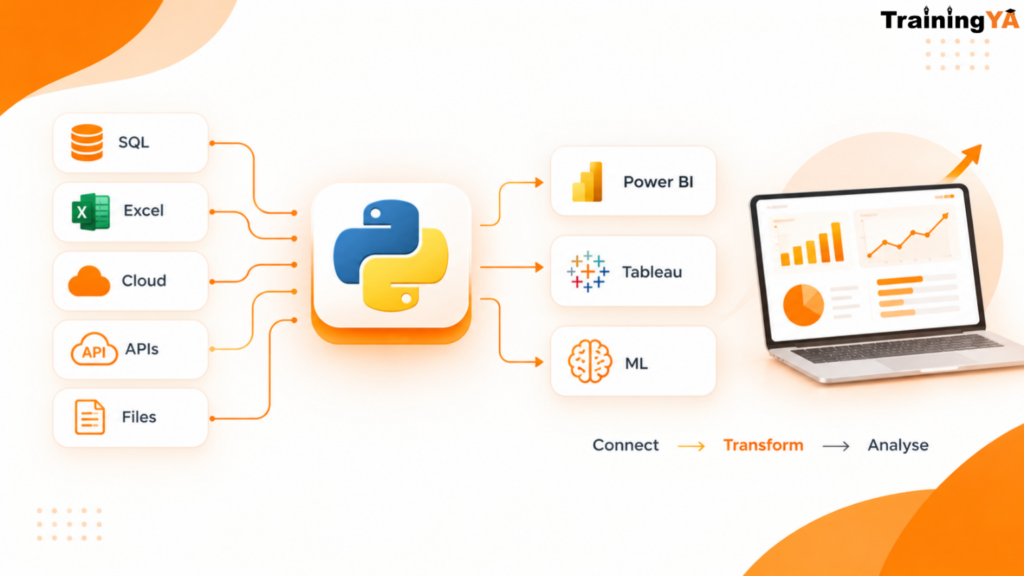
Python offers this programming interface. The aim is not to replace the BI stack with code, but to decrease the friction between the different tools. A solid workflow involves using SQL for set-based extraction, Python for any complex or reusable transformations, and Power BI or Tableau for displaying the final metrics. This way of dividing up the tasks is generally more maintainable than forcing all the steps into a single platform.
Major changes: what has made Python more important for Data Science
1. The Python ecosystem has become a layered data platform
Python by itself does not include all the capabilities needed for data science; rather, its power lies in the range of tools available around it. NumPy permits efficient computing with multidimensional arrays and forms the numerical basis for scientific and analytical tasks. pandas provides labeled tabular structures and a set of operations for reading, cleaning, reshaping, grouping, and analyzing data. Matplotlib enables general-purpose plotting and Seaborn gives a higher-level interface for statistical visualization that works together with both pandas and Matplotlib.
The advantage from an architectural point of view is that a single language can carry out the whole process, from handling the raw data to producing the analytical results, so there is no need to translate the work between different programming models. As a result, the cost of carrying out experiments is reduced and it becomes easier to turn analyses into reusable code.
2. Machine learning is integrated into the same workflow
Scikit-learn provides a uniform API for tasks concerning both supervised and unsupervised learning, as well as for data preprocessing, model selection, evaluation, and the construction of pipelines. The abstracts it offers—namely estimators, transformers, and Pipelines—separate the process of preparing the data from that of fitting the model and thus lower the chance of inconsistent transformations when going from training to evaluation.
This is important since the value of a model is based on the whole process—this includes feature preparation, validation, preventing data leakage, measuring performance, and guaranteeing reproducibility. The ecosystem of Python combines all of these actions into one programmable workflow.
3. Notebooks turned analysis into an interactive engineering surface
Jupyter notebooks make it easy for analysts to use Python for Data Science since they allow code, narrative text, data, charts, and interactive outputs to be combined into a single shareable document. This format supports the processes of exploration, explanation, prototyping, and communication. Although Python is the default kernel within the Jupyter ecosystem, Jupyter itself is not limited to a particular language.
The greatest advantage from a professional point of view is quick feedback; it is possible within a single environment to examine data, test hypotheses, visualize distributions, compare different approaches and document the reasoning. The problem is that exploratory notebooks can become unsuitable for use in a production environment unless they are refactored into modular, tested code with clearly defined dependencies.
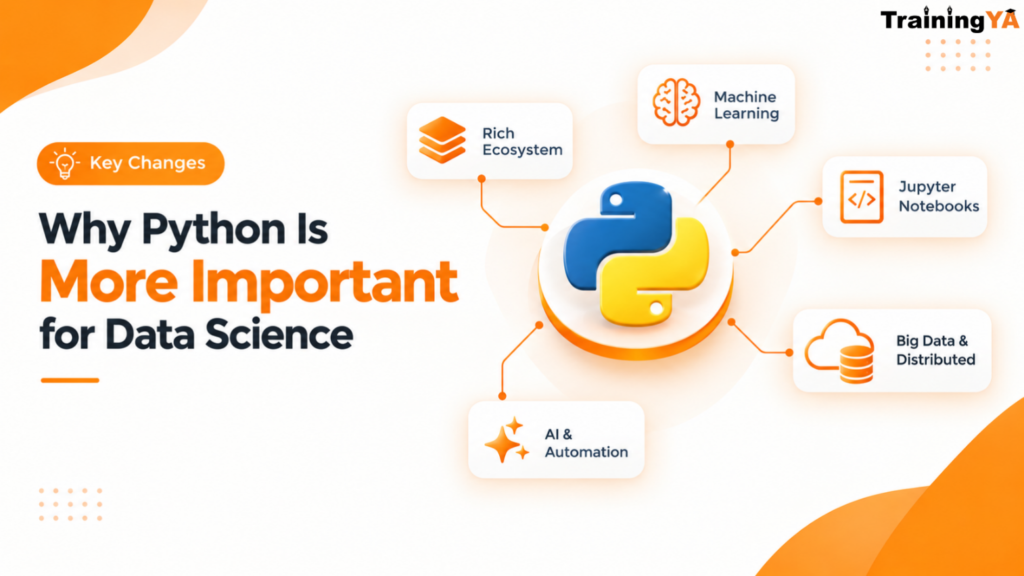
4. Python now reaches beyond the single-machine DataFrame
The significance of Python goes well beyond its use with small datasets. Apache Arrow provides a columnar format and various data tools to enable fast data interchange and in-memory analytics, and it includes Python bindings that combine with NumPy and pandas. PySpark offers a Python API for distributed processing, covering Spark SQL, DataFrames, Structured Streaming, and machine-learning features. Because of these technologies, Python retains relevance as both the amount of data and processing requirements grow.
Python shouldn’t process each row individually; instead it usually acts as an interface and coordination layer, with optimized native or distributed engines carrying out the heavy computing. Experienced professionals assign the work to SQL, columnar engines, vectorised operations, or distributed systems rather than employing Python loops when operating on large datasets.
5. AI has expanded, rather than replaced, the need for programmable data workflows
The role of data preparation, evaluation, retrieval, automation, and model integration has been enhanced by modern AI. Python is well placed to meet this change since its ecosystem for data preparation and machine learning is already in place and it is capable of calling external APIs, database systems, web services, and model endpoints.
The main point is that it’s not necessary for every analyst to become an AI engineer, but that Python skills now connect classical analytics with AI-powered workflows. Analysts who are able to work in descriptive analytics, statistical reasoning, machine learning, and automation have more career prospects than those who are merely skilled in visualisation tools.
The Python Data Science stack in one view
| Numerical computing | NumPy | Arrays, numerical operations, scientific foundations | Avoid scalar Python loops when vectorized operations are available |
| Tabular analysis | Pandas | Cleaning, joining, reshaping, grouping, time-series work | Be deliberate about memory, dtypes, indexes, and reproducibility |
| Visualization | Matplotlib / Seaborn | Exploration, diagnostics, statistical communication | Choose the chart to answer the decision question, not to decorate the report |
| Machine learning | Scikit-learn | Preprocessing, models, validation, evaluation | Treat the pipeline and validation design as seriously as the algorithm |
| Interactive analysis | Jupyter / IPython | Exploration, experiments, narrative analysis | Refactor important notebook logic into tested modules |
| Data interchange | Apache Arrow / PyArrow | Columnar interchange, in-memory analytics, Parquet workflows | Use fit-for-purpose storage and interchange formats |
| Distributed processing | PySpark | Large-scale and distributed transformation/analysis | Push scale-sensitive work into the distributed engine rather than Python loops |
Practical impact on professionals
The primary reason for learning Python in the field of Data Science should be to broaden the range of work that professionals are able to handle, rather than merely adding a item to their résumé. Rather than being limited to producing just reports or queries, they can take responsibility for the underlying data logic.
For experienced data analysts
Python is able to get rid of repetitive spreadsheet tasks, standardise the preparation of data, automate the checks, and improve reproducibility. pandas is particularly useful since its DataFrame model corresponds to the tabular structures that are familiar from both SQL and spreadsheets. Professionals move from saying ‘I can clean this file’ to saying ‘I can define and rerun the cleaning process’.
For Power BI and BI developers
Python works best when it is used to supplement the BI platform rather than to compete with it. Members of BI teams can make use of SQL for source transformation, Power Query for data shaping, DAX for semantic calculations, and Python for custom preprocessing, for anomaly detection, for orchestrating files or APIs, or for carrying out model-driven tasks. The important issue to address is which layer should be responsible for a particular piece of logic, not whether Python is more powerful than Power BI.
This is also a matter of governance. Where the same KPI is calculated using SQL, Python, Power Query, and DAX, the organisation could end up with several different definitions of ‘revenue’. Although Python enhances capabilities, it is necessary to exercise disciplined ownership of the business logic to avoid fragmentation.
For business analysts and managers
The value of knowing Python is usually only indirect since managers do not need to write all the scripts themselves, but by understanding Python’s ability to automate work teams tend to change the way they carry out their tasks. Weekly manual exception files can turn into scheduled processes, static analyses can become reusable models, and one-off segmentation exercises can turn into auditable workflows.
For professionals switching into Data Science
Python acts as a basic technical foundation and is useful even before one gets to advanced machine learning. Students can begin by studying functions, data structures, files, and modules, then move on to data manipulation, visualization, statistics, and finally machine learning. This approach is more sustainable than simply memorizing the names of models.
Business implications
1. Lower handoff cost
The handover of work between analysts, engineers, and reporting teams leads to delays and raises the chance of misinterpretation. By using Python workflows, the various steps which would normally have to be carried out by repeatedly exporting, copying, filtering, and reformatting are combined. The business advantage is a shorter cycle time and greater consistency, not just quicker computation.
2. More repeatable analytics
It is hard to audit manual reports. Scripts, on the other hand, can be versioned, reviewed, have their parameters set, and be rerun, which makes the logic clear and possible to inspect. This point is important in the case of regulated, financial, operational, or customer-facing analytics.
3. Better reuse of analytical logic
Whenever a transformation proves itself to be useful it is probably going to be useful once again. Python functions and modules enable teams to package up transformations, validation routines, feature engineering techniques, and utility code, thus cutting down redundant work in reports and notebooks.
4. Greater technical range for teams
Python connects business analytics with engineering and is therefore useful for teams that are expanding their data stacks but have limited engineering resources. The fact that it offers such flexibility, though, means that greater responsibility is placed on aspects such as code quality, environment management, testing, and security.
Technical considerations: where Python is strong and where it is not
The notion that the ‘most important programming language’ means ‘the best at every kind of data problem’ is wrong; a more suitable technical evaluation should consider the features of the workload.
| Complex analytical logic | Functions, modules, libraries, tests, APIs | SQL, BI, orchestration tools | Code ownership and testing become necessary |
| Large relational transformations | Can orchestrate and validate complex logic | SQL/database engine | Do not pull huge tables into memory just to use Python |
| Tabular exploration | Fast iteration with pandas | Jupyter, SQL, spreadsheets | Memory usage can become the bottleneck |
| Machine learning | Strong ecosystem and reusable APIs | Feature stores, model serving, cloud compute | Model quality depends on data and validation, not language choice |
| Executive reporting | Can automate upstream data preparation | Power BI, Tableau, Excel | Python is not the business-facing dashboard itself |
| Distributed processing | PySpark and other distributed interfaces | Cloud/data platforms | Scale requires architecture, not just more Python code |
A simple architectural rule
Carry out the computation with the system that is most appropriate for the task. SQL should be used for set-based database operations, vectorized data libraries for in-memory analysis and distributed engines for large-scale workloads. Python should be used to coordinate the various steps, to express the business logic that needs to be programmed, and to link the different components together. This method avoids the usual error of applying Python to every performance problem.
Example: turning a manual analyst task into a reusable workflow
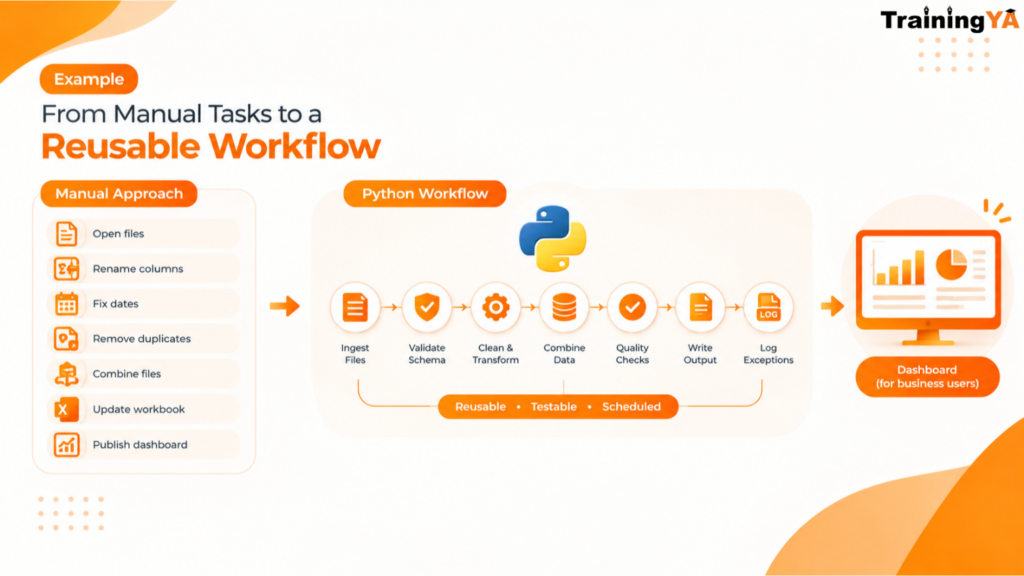
Imagine a finance team that gets monthly CSV files from a number of business units. In the traditional approach they open each file, rename the columns, correct the dates, get rid of the duplicates, combine the files, update an Excel workbook, and then publish the dashboard. Using Python, the entire workflow is turned into a series of functions: one to ingest the files, another to validate the schema, another to normalise the fields, one to combine the data, one to carry out quality checks, one to write the curated output, and one to log the exceptions. The dashboard tool stays the same for the business users, while Python makes the process upstream repeatable.
import pandas as pd
files = [‘north.csv’, ‘south.csv’, ‘west.csv’]
frames = [pd.read_csv(f) for f in files]
df = pd.concat(frames, ignore_index=True)
df[‘order_date’] = pd.to_datetime(df[‘order_date’], errors=’coerce’)
df = df.drop_duplicates(subset=[‘order_id’])
The code is simple. Its value in a professional context is that it can be reviewed, have its logic parameterized, be tested, be scheduled, and be reused. The workflow in production should also include schema validation, logging, exception handling, and the management of environments together with controlled output paths.
Risks, limitations, and governance
While Python provides new capabilities, it also increases both the chance for attacks and the amount of work required for maintenance. Therefore, teams should take these risks into account before deciding to use Python for their Data Science workflows.
| Performance and memory | A vectorized pandas operation can be efficient, but an in-memory DataFrame still needs memory. Pulling multi-gigabyte datasets into a workstation can be a design failure even if the code is syntactically correct. | Push filters and aggregations into SQL, use columnar formats where appropriate, stream or chunk when feasible, or move to distributed processing. |
| Dependency sprawl | A project that imports dozens of packages can become difficult to reproduce or secure. | Pin or constrain dependencies, isolate environments, document versions, and remove unused packages. |
| Notebook-to-production gap | Exploratory code can rely on hidden state, cell execution order, local files, and undocumented assumptions. | Move production logic into modules, add tests, define inputs/outputs, and automate execution. |
| Data leakage and invalid evaluation | Machine-learning pipelines can accidentally use information from the future or from the test set. | Separate training and test logic, use appropriate cross-validation, and make preprocessing part of the pipeline when possible. |
| Security | Scripts may contain credentials, call external APIs, read uncontrolled files, or install untrusted packages. | Use secret management, least privilege, controlled package sources, code review, and secure execution environments. |
| Metric fragmentation | Multiple Python scripts can create multiple definitions of the same business metric. | Establish metric ownership, semantic definitions, and a single source of truth for executive KPIs. |
Skills professionals should develop.
A good roadmap for Python Data Science should emphasize skills rather than particular libraries, and individuals need to move on from programming basics to analytical engineering, rather than simply memorizing individual functions.
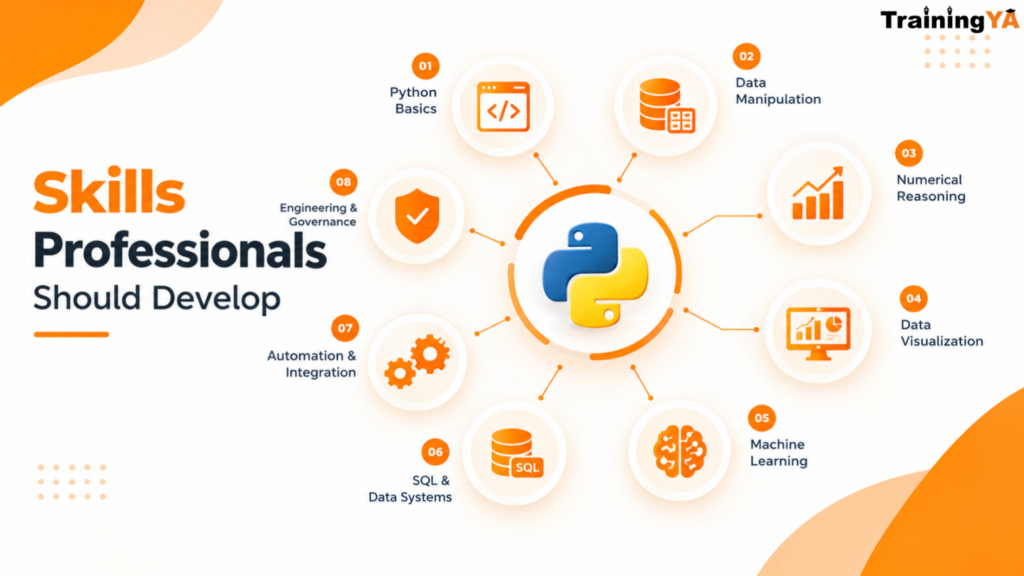
1. Core Python programming
We should concentrate on variables and data types, control flow, functions, modules, exceptions, comprehensions, file handling, object-oriented concepts, environments, and debugging; the aim is to produce reliable code, not simply to gain notebook fluency.
2. Data manipulation with Python
Learn how to carry out DataFrame operations, joins, groupby functionality, reshaping, deal with missing data, manage dates, handle strings, work with categorical fields, deal with data types, and perform validation. You should also be able to explain the way in which the code changes the dataset.
3. Numerical reasoning
Make sure you understand arrays, vectorization, matrix operations, probability, descriptive statistics, sampling, correlation, regression, and the assumptions that lie behind the common techniques.
4. The use of Python for data visualization
Examine distributions, relationships, outliers, missing data, and model behaviour using Matplotlib and Seaborn. Consider visualization to be an analytical method rather than merely a tool for presentation.
5. The use of Python for machine learning
You ought to study preprocessing, feature design, the rules for dividing the data into training and test sets, cross-validation, assessment criteria, standard models, comparing models, and interpreting the results before dealing with complex algorithms.
6. SQL and the data systems
Python skills are far more valuable when they are combined with a good understanding of SQL. It is important to know how data is stored, how joins work, why filters should be located near the source, and the effect that query performance has on downstream analysis.
7. Automation and integration
It is in this field that Python starts to create operational leverage, through features including APIs, JSON, scheduled jobs, logging, configuration, reusable scripts, and controlled outputs.
8. Engineering and governance
The features that set an analyst script apart from a reliable production workflow are git, code review, testing, package management, environment isolation, secrets handling, documentation, reproducibility, and observability.
When should you use Python? A practical decision framework.
There is no reason for professionals to use Python just because it is available; they should use it when at least one of the following conditions is met:
- What you need is logic that is reusable rather than having it entered manually.
- The process includes files, APIs, databases, and a variety of different downstream tools.
- The change is either too customised or too routine for the analytics interface that we currently have.
- You need statistical models, machine learning techniques, or experiments carried out by means of programs.
- You need automatic data quality checks, error handling, and executions that are scheduled.
- It is to be expected that the analytical workflow will become one that is maintainable and kept under version control.
You ought to carry on using SQL, Excel, Power BI, Tableau, or some similar dedicated tool whenever it is the most efficient and appropriately governed one for the task; Python should only be introduced when it serves to simplify things or enhances capabilities, not when it creates an extra layer for no specific reason.
Real-world situations
Scenario 1: A reporting analyst with a recurring Excel process
The problem is that the same twelve cleanup steps have to be carried out on different files. The method recommended for professionals is to use pandas in conjunction with standard Python functions in order to automate the processes of data ingestion, validation, transformation, and output, after which the final report is placed in Excel or Power BI. The benefit is repeatability and a reduction in manual work — it does not necessarily mean that the calculation for a single file is done more quickly.
Scenario 2: A Power BI developer facing custom preprocessing
The problem is that the data is obtained from a number of APIs which have inconsistent field names, nested JSON structures, and irregular update behaviours. It is possible to normalise the payloads, validate the schemas, log any failures, and provide the BI layer with a clean data product by means of a Python ingestion layer. Consequently, business reporting stays stable even though the upstream APIs are messy.
Scenario 3: A manager wants an exception-based operational report
The problem is that the team has to spend hours going through tens of thousands of transactions in order to spot only a few abnormal cases. Python can be used to automate either the scoring or the application of the rules, prepare an exception table, and pass the results on to the reporting or workflow system; this means that the manager is given a focused decision queue instead of a raw dataset.
Scenario 4: A data scientist needs a repeatable model workflow
The problem is that the prototype works correctly when it is run on a notebook but cannot be reliably reproduced. The right thing to do is to define the data contract, transfer the data cleaning and modelling steps into a pipeline, formalise the evaluation procedure, clarify the version dependencies and the artefacts involved, and establish a method for execution that is repeatable. The programming language employed is Python; what matters most in this case is engineering practice.
What this means for TrainingYA learners and professionals
For TrainingYA’s audience, the best method of learning is not to study Python by itself. The institute’s current course pages provide practical and career-oriented learning in the areas of Python, Data Science, machine learning, data analytics, SQL, Tableau, Power BI and Excel, making use of real datasets and comprising assignments, case studies and projects.
The method in which modern analytics are in fact carried out corresponds to that combination. Those analysts who are moving into the field of Data Science should improve their Python skills by also picking up SQL and analytical reasoning. Professionals in the area of business intelligence ought to look into the way Python can complement – not duplicate – the reporting tools already in use. Individuals changing careers should produce a full project which demonstrates data acquisition, data cleaning, analysis, visualization, model evaluation, and business interpretation.
As Python is a fundamental skill, learners should use it as a basis—that is, treat it as a single language which connects the analytical tools they are already familiar with and provides a path from basic scripting to more advanced Data Science workflows. The training should concentrate on projects and on solving problems in a consistent way, since possessing a list of completed libraries alone does not demonstrate professional ability.
Frequently Asked Question
Python is important because it offers one programming environment for use in data preparation, analysis, visualization, machine learning, automation, and system integration; the value of Python is just as much the result of the range of tools and resources available for the language as it is due to the language itself.
They are facing different types of problems. SQL is usually the right option when it comes to retrieving relational data and performing set-based transformations close to the database, while Python is more appropriate for procedural logic, reusable code, statistical analysis, machine learning, automation, and the integration of several systems. Indeed, experienced Data Science professionals generally use both.
Of course. When considering the subject, analysts could start off with the more practical programming elements such as functions, files, pandas, visualization, APIs, and automation; subsequently, as the emphasis shifts to workflows, software-engineering practices including testing, version control, environments, and logging constitute the next stage.
If you want to create a practical foundation, start off with NumPy and pandas for data processing, then use Matplotlib and Seaborn for visualization and incorporate scikit-learn for classical machine learning; after that, add Jupyter for interactive analysis and finally proceed to PyArrow, PySpark, or other tools according to the particular workload.
Of course, but it is not sufficient merely to load all the datasets into a local DataFrame. When handling larger workloads, experts ought to use SQL at the source, along with columnar formats and engines, chunked or streaming methods, or distributed processing such as PySpark if appropriate.
Of course. Even though AI can speed up the process of generating and analysing code, professionals still have to define the data requirements, examine the outputs, evaluate the models, handle the dependencies, and integrate the workflows with business systems. Performing these tasks requires technical judgment, not exclusively the generated code.
The most effective method is to concentrate on the basic principles of programming and to make use of pandas when manipulating data, as well as to have skills in SQL, statistics, visualisation, model evaluation, automation, APIs, version control, testing, and reproducibility. It is more important to go into depth with a smaller number of relevant skills than to have only a superficial knowledge of a large number of libraries.
Start by looking at the responsibilities that you currently have and automate one real workflow; then proceed to data manipulation, visualisation, statistics, machine learning, and engineering practices. Select projects that result in measurable business outputs rather than those which are merely standalone coding exercises.
Conclusion: Python is important because it compounds the value of other data skills
The best reason for choosing Python in the field of data science is not because it has the simplest syntax or the greatest number of tutorials. Rather, it is because Python enables professionals to carry out their analytical intentions throughout the modern data stack. While SQL can be used for retrieving and amassing data, Power BI and Tableau are capable of presenting the results, Excel can still be useful for local business analysis, data platforms can offer storage and scaling capabilities, and Python is what allows these different components to be linked together, the handoffs between them to be automated, custom logic to be expressed, statistical and machine-learning workflows to be supported, and repeatable processes to be established.
Python programming in the field of Data Science therefore represents a highly advantageous skill for experienced professionals, particularly since it can be combined with SQL, an understanding of business issues, statistics, BI tools, and good engineering practices. The aim of the professional should not be to become ‘the Python person’; rather, it should be to become the individual who is able to tackle a complicated analytical problem, select the appropriate tools, set up a dependable workflow, and produce an outcome that the business can trust.








Leave a Reply